Technology · Article
How Encryption Works: A Guide to Digital Privacy Protection
Published:
In brief
Encryption protects digital information by scrambling it with mathematical algorithms so only someone holding the correct key can read it. Modern systems typically combine two types of encryption — symmetric and asymmetric — to secure everything from messaging apps to online banking, and regulators are now preparing new standards to withstand future quantum computers.
Encryption is the process of converting readable information, known as plaintext, into an unreadable form called ciphertext, using a mathematical algorithm and a secret value called a key. Only someone who has the matching key can reverse the process and recover the original data. This single mechanism underlies most of what people call "digital privacy" today, from secure messaging to online banking.
Two basic types: symmetric and asymmetric
Cryptographic systems generally fall into two categories. Symmetric encryption uses a single secret key to both lock and unlock data: both the sender and the receiver must already have the same key, according to privacy company Proton. This makes symmetric encryption fast, but it creates a practical problem — the key itself has to be shared somehow without being intercepted.
Asymmetric encryption solves that problem by using two mathematically linked keys: a public key that can be shared openly, and a private key that is kept secret. Data encrypted with one key can only be decrypted with the other, so there is no need to exchange a secret in advance. The trade-off is speed: Proton notes that asymmetric encryption is roughly 1,000 times slower than symmetric encryption because its underlying mathematics is far more complex.
Because of this trade-off, most real-world systems use a hybrid approach: asymmetric encryption is used briefly to exchange a one-time symmetric key over an open network, and then the fast symmetric algorithm handles the actual bulk data. This combination powers HTTPS website connections, virtual private networks (VPNs) and encrypted email, Proton explains.
AES: the standard behind most everyday encryption
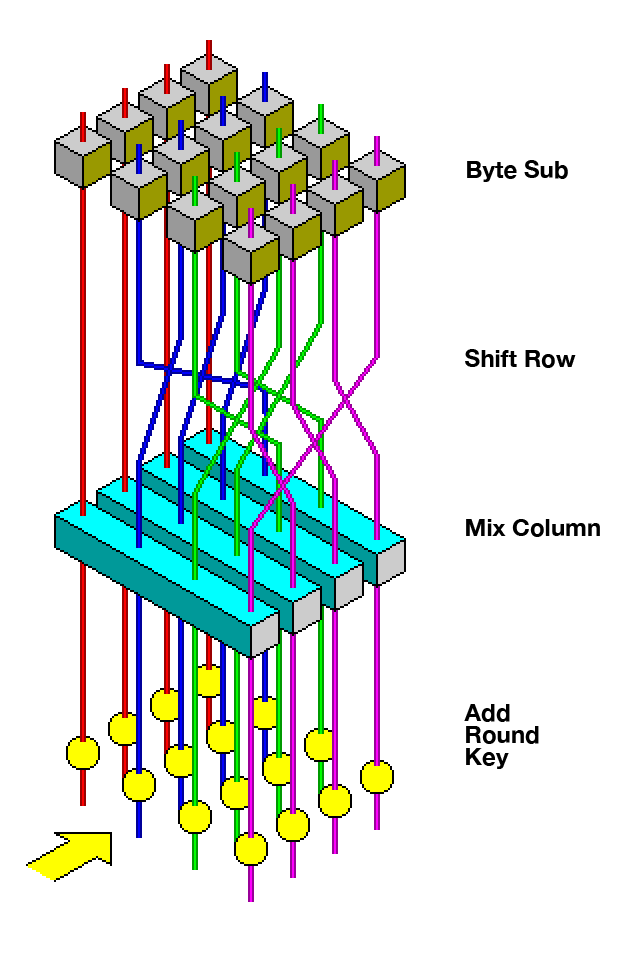
The most widely used symmetric algorithm is the Advanced Encryption Standard (AES), published by the U.S. National Institute of Standards and Technology (NIST) on November 26, 2001, as Federal Information Processing Standard (FIPS) 197. AES supports key lengths of 128, 192 or 256 bits and processes data in 128-bit blocks. NIST describes it as a FIPS-approved algorithm that can be used to protect electronic data, and it is used across government and commercial systems worldwide.
What makes encryption "end-to-end"
Not all encryption offers the same level of protection. Standard encryption "in transit," such as the TLS protocol used in HTTPS, protects data only while it moves between a device and a server — but the data can still be readable once it reaches that server. End-to-end encryption (E2EE) goes further: according to IBM, data stays encrypted in transit and is only decrypted on the recipient's device, meaning even the service provider carrying the message cannot read its content.
IBM describes E2EE as working in four stages: an algorithm turns the message into ciphertext; the ciphertext travels across the network looking like random characters to any interceptor; the recipient's device uses a private or shared key to restore the original message; and the data is then checked for integrity to confirm it was not tampered with in transit. IBM lists messaging platforms such as WhatsApp, Signal and Apple's iMessage, as well as password managers like 1Password and Bitwarden, as examples of services that apply end-to-end encryption.
| Feature | Symmetric encryption | Asymmetric encryption |
|---|---|---|
| Keys used | One shared secret key | Public key + private key pair |
| Typical key size | 128–256 bits | 2048+ bits (RSA); 256+ bits (ECC) |
| Speed | Fast | About 1,000x slower than symmetric |
| Common algorithms | AES, ChaCha20 | RSA, ECDH, Ed25519, ML-KEM |
| Typical use | Encrypting large volumes of data (files, VPN traffic) | Key exchange, digital signatures |
Why quantum computers are changing encryption standards
Regulators are already preparing for a future threat: sufficiently powerful quantum computers could, in theory, break the mathematical problems that today's asymmetric encryption relies on. On August 13, 2024, NIST approved three new Federal Information Processing Standards built specifically to resist attacks from both classical and quantum computers, according to NIST's Computer Security Resource Center (CSRC).
The three standards are FIPS 203, the Module-Lattice-Based Key-Encapsulation Mechanism Standard (derived from the CRYSTALS-Kyber submission); FIPS 204, the Module-Lattice-Based Digital Signature Standard (derived from CRYSTALS-Dilithium); and FIPS 205, the Stateless Hash-Based Digital Signature Standard (derived from SPHINCS+). NIST's CSRC states the standards are "designed to resist future attacks by quantum computers, which threaten the security of current standards," covering both key exchange and the digital signatures used to verify that data has not been altered.
What this means for everyday privacy
For most people, the practical takeaway is that encryption already protects much of daily digital life by default — HTTPS secures web browsing, AES secures files and Wi-Fi traffic, and E2EE protects many popular messaging apps. The ongoing shift toward post-quantum standards is mainly a background infrastructure change, managed by standards bodies, device makers and service providers, rather than something individual users need to configure themselves.
Questions
- What is the difference between encryption and end-to-end encryption?
- Regular encryption, such as the TLS used in HTTPS, protects data only while it travels between a device and a server, where it can potentially be read. End-to-end encryption keeps data encrypted all the way until it is decrypted on the recipient's own device, so even the service provider cannot read the content, according to IBM.
- What is AES and why is it used so widely?
- AES (Advanced Encryption Standard) is a symmetric encryption algorithm published by NIST in 2001 as FIPS 197. It supports 128-, 192- or 256-bit keys and is approved for protecting electronic data across government and commercial systems.
- Why do systems use both symmetric and asymmetric encryption together?
- Asymmetric encryption avoids the need to share a secret key in advance but is around 1,000 times slower than symmetric encryption, according to Proton. Hybrid systems use asymmetric encryption briefly to exchange a session key, then switch to fast symmetric encryption for the actual data — this is how HTTPS and VPNs work.
- Can quantum computers break current encryption?
- Quantum computers capable of breaking today's widely used asymmetric encryption do not yet exist, but NIST has already approved new post-quantum standards (FIPS 203, 204 and 205) in August 2024 specifically designed to resist future quantum attacks, according to NIST's CSRC.
- Which apps use end-to-end encryption?
- IBM lists WhatsApp, Signal and Apple's iMessage as messaging services that use end-to-end encryption for all communications, along with password managers such as 1Password and Bitwarden for stored credentials.
Sources
This piece was prepared with artificial intelligence and passed an automated source check before publication. If you see an error, ask for a correction. Request a correction or reply · How we make this
Related
TechnologyNews
Gaza AI-targeting documentary NAZA sparks political backlash in Israel, opens in 500 French cinemas
NAZA, a documentary by Israeli filmmakers Yuval Abraham and Rachel Szor on artificial intelligence in Israeli military targeting in Gaza, won a Special Jury Prize at the 2026 Venice Film Festival and triggered an Israeli government backlash, including threats to strip the directors' citizenship. The 80-minute film opened in 500 French cinemas on October 12-13, 2026, and is set to stream free via The Guardian in November.
TechnologyArticle
Joe Rogan's Spotify Renewal Shows How Podcast Power Has Shifted to Creators
Spotify and Joe Rogan announced a new multi-year licensing agreement on October 8, 2026, six years after their original 2020 deal — but this time without exclusivity, letting "The Joe Rogan Experience" stream on multiple platforms at once. The renewal, reported at roughly $250 million by The Wall Street Journal, illustrates a broader industry shift: platforms increasingly license and distribute creator-owned shows rather than lock them into exclusive contracts.
TechnologyNews
ASOS confirms data breach after hackers hijack app to send "ASOS HACKED" alert
UK online fashion retailer ASOS has confirmed that hackers broke into a third-party platform linked to its app and accessed customer personal data, including names, addresses, phone numbers and email addresses. The company says passwords and full payment card details were not affected, but a group calling itself Xuanye Group later shared a larger data sample with reporters.
TechnologyArticle
How Meta's Muse AI Agent Works: Architecture, Safety and Rollout Explained
Meta's Muse is an "agentic" AI system that acts on a user's behalf — booking travel, filling forms and sending emails — rather than just answering questions. It runs each user's agent inside an isolated virtual machine and routes every external action through a separate permission system called Sentinel, according to Meta's own technical blog. The system launched publicly on September 8, 2026, after internal safety concerns had been raised during testing, according to reporting by the New York Times as covered by other outlets.