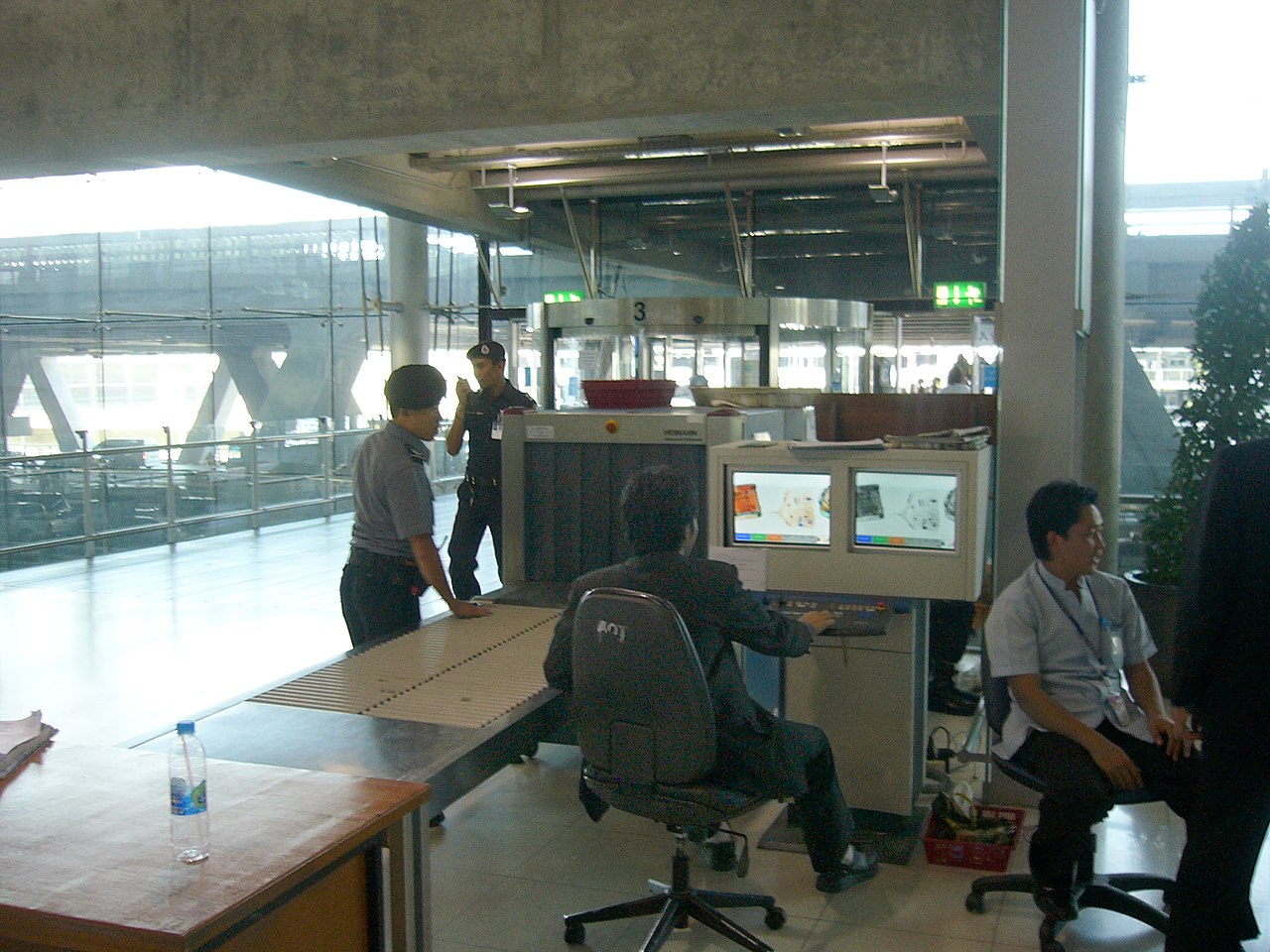
How to Get Through Airport Security: A Step-by-Step Guide for Flyers
Published:
Image credit: User:Mattes · Public domain · Wikimedia Commons
In brief
Flying smoothly comes down to timing, documents and packing: arrive about 2 hours early for domestic and 3 hours early for international flights, keep liquids to 100ml containers unless your airport has newer scanners, and carry acceptable ID. This guide walks through check-in, security screening and arrival procedures using current official and consumer-protection guidance.
Air travel runs on predictable steps: check-in, security screening, boarding and, for international trips, immigration and customs. Knowing what each stage requires — and what changes depending on where you fly — reduces the chance of a missed flight or a confiscated item.
How early to arrive at the airport
Financial guidance site NerdWallet recommends arriving at least two hours before departure for domestic U.S. flights and at least three hours before departure for international flights, to allow time for check-in, bag drop, security screening and, on international routes, passport and customs checks.
The same guidance notes that security lines can run longer during peak travel periods, and that online check-in — typically available starting 24 hours before departure through an airline's website or app — can save time once at the airport. Trusted-traveler programs such as TSA PreCheck and CLEAR can speed up the security line itself.
Identification: what counts as acceptable ID
In the United States, the Transportation Security Administration has required a REAL ID-compliant driver's license — identifiable by a small gold star in the top right corner — or another approved document to board domestic flights since May 2025, according to reporting by Borderless Magazine. A valid U.S. passport is also accepted in place of a REAL ID.
Since February 1, 2026, travelers who show up without a REAL ID, passport or other accepted document can pay a $45 fee to go through TSA's ConfirmID identity-verification process instead of being turned away, the same report states.
The liquids rule: 100ml is still the global default
The long-standing baseline rule limits liquids, gels, aerosols, creams and pastes in carry-on bags to containers of 100ml (3.4oz) or less, all fitting inside one transparent, resealable bag per passenger. UK government guidance (gov.uk) describes this bag as holding no more than a litre and measuring roughly 20cm by 20cm, and states the bag must not be tied closed.
Exceptions generally apply to medically necessary liquids, baby food or milk, and special dietary liquids, which may exceed the standard limit — gov.uk guidance allows up to 2 litres for these categories — but travelers are usually asked to declare them separately at the checkpoint.
New scanners are changing the rule — but unevenly
Some airports have installed CT (computed tomography) scanners that produce a 3D image of a bag's contents, letting passengers leave liquids and laptops inside their cabin bag and, where fully enabled, carry up to 2 litres of liquid. Consumer group Which? reported that as of January 23, 2026, airports including Heathrow, Gatwick, Edinburgh, Birmingham, Bristol, Belfast International and Belfast City had moved to the 2-litre allowance, while Luton and Manchester still enforced the traditional 100ml limit, though liquids could stay in the bag without needing a separate clear pouch there.
Which? also cautioned that a traveler's return airport may not have the newer scanners, so items allowed through security on departure are not guaranteed to be allowed on the way back. The advice from gov.uk and Which? is the same: check the specific departure and arrival airport's current rules before packing.
Step-by-step: from check-in to the gate
Check in online or via the airline app, typically from 24 hours before departure, and get a mobile or printed boarding pass.
Arrive at the airport roughly 2 hours before a domestic flight or 3 hours before an international flight, allowing extra time during peak periods.
Drop checked baggage at the airline counter or self-service kiosk if you are not traveling with carry-on only.
Have an accepted ID ready — a REAL ID-compliant license, passport, or other TSA-approved document for U.S. domestic flights — along with your boarding pass.
At the checkpoint, place your liquids bag, laptop and other required items in trays as directed by staff; rules on what stays in the bag depend on whether the airport uses CT scanners.
Proceed through the body scanner or metal detector; follow screening officers' instructions, including any additional pat-down or bag check.
Collect your belongings, head to the departure gate, and listen for boarding announcements.
Common items that cause delays
Liquid containers over the local limit (100ml at most airports, up to 2 litres at some upgraded ones) packed loose rather than declared.
Laptops or electronics left inside bags at checkpoints that still require them removed.
Lighters carried outside the required resealable bag — UK rules allow only one lighter, and it must stay in a bag like the one used for liquids.
Travel documents that do not meet the destination's ID standard, such as a non-REAL ID license without a passport for U.S. domestic flights.
The airport at your destination may not have the new scanners in use.
— Which?, UK consumer group, on returning travelers facing different rules than their outbound airport
Questions
How early should I get to the airport?
General guidance cited by NerdWallet recommends at least 2 hours before a domestic flight and at least 3 hours before an international flight, with extra buffer time during busy travel periods.
What is the liquids limit for carry-on bags?
The default rule at most airports is containers of 100ml or less, all fitting in one transparent resealable bag per passenger, per UK government (gov.uk) guidance. Some airports with new CT scanners, such as Heathrow and Edinburgh, now allow up to 2 litres, according to Which?
Do I need a REAL ID to fly within the US?
Yes — since May 2025, U.S. domestic flyers need a REAL ID-compliant license (marked with a gold star) or another accepted document such as a passport, according to reporting by Borderless Magazine. Travelers without one can pay a $45 fee for TSA's ConfirmID process, in effect since February 1, 2026.
Can I bring medicine or baby food above the liquid limit?
Yes. Gov.uk guidance states that medically necessary liquids, baby food or milk, and special dietary liquids can exceed the standard 100ml limit, up to 2 litres, though they are usually screened or declared separately.
Will my liquids be allowed at both my departure and arrival airport?
Not necessarily. Which? reported that some UK airports allow up to 2 litres of liquid due to new scanners while others still cap it at 100ml, so travelers should check rules at both the departure and return airport before packing.
This piece was prepared with artificial intelligence and passed an automated source check before publication. If you see an error, ask for a correction. Request a correction or reply · How we make this
Ecotourism means traveling to natural areas in a way that protects the environment, supports local livelihoods and educates visitors, according to The International Ecotourism Society. This guide explains the difference between ecotourism and the broader term "sustainable tourism," what data show about tourism's environmental footprint, and concrete steps travelers can take, from checking certifications to timing trips around crowds.
U.S. airport security still runs on the 3-1-1 liquids rule: containers of 3.4 ounces or less, all fitting into one quart-size clear bag. Shoes no longer have to come off for most travelers since July 2025, but power banks and spare lithium batteries must stay in carry-on bags, and airlines are now adding their own limits on how many you can bring.
Planning an affordable trip starts with setting a budget before picking a destination, then timing flight and insurance purchases to known discount windows. Data from flight-booking platforms and a major airfare study show domestic tickets are cheapest roughly three to eight weeks before departure, while travel insurance should generally be bought within two to three weeks of the first trip payment to keep full benefits.
Budget travel comes down to three levers: when you book and fly, where you sleep and eat, and which destination you pick. Data from Expedia's 2026 Air Hacks Report (via AFAR) and travel-cost guides from Going and Nomadic Matt show concrete ways to cut each of those costs, from the cheapest day to fly to five-dollar local meals.