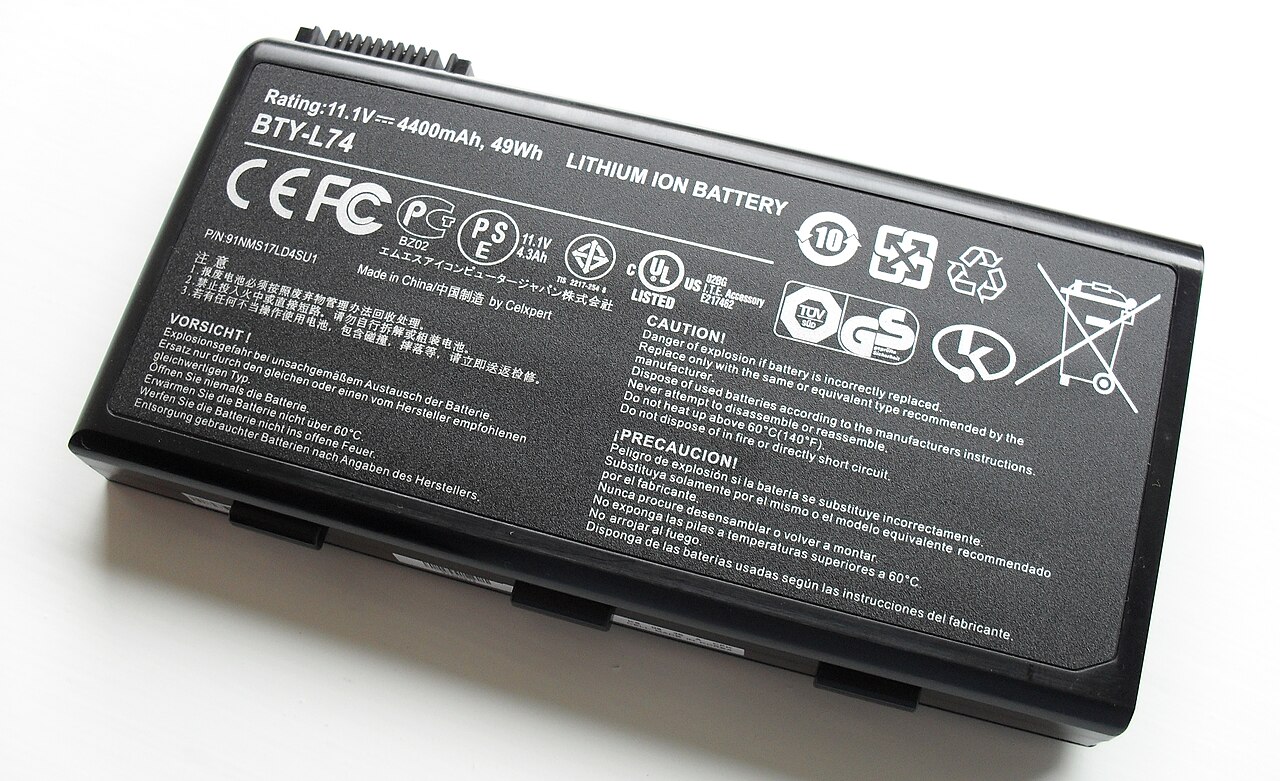
A lithium-ion battery stores energy by moving lithium ions between two electrodes — the anode and the cathode — through a liquid electrolyte. In an electric vehicle, thousands of these cells are grouped into modules and then a pack, managed by electronics that control voltage, temperature and charging speed.
A lithium-ion battery is an energy-storage device in which lithium ions move back and forth between two electrodes to store and release electrical energy. EnergySage, a U.S. clean-energy information site, notes that the technology is used in electric vehicles because it combines a favorable power-to-weight ratio with efficient energy use, stable performance in hot conditions, and a low self-discharge rate.
The basic components
Every lithium-ion cell has four core parts, according to the battery-component manufacturer Ennovi: the anode (negative electrode), the cathode (positive electrode), the electrolyte, and a separator that keeps the two electrodes apart while still letting ions pass through. Anodes are typically made of graphite, which stores lithium in an optimized structure. Cathodes are usually metal oxides — common EV formulas include nickel-manganese-cobalt oxide (NMC), nickel-cobalt-aluminum oxide (NCA), or lithium iron phosphate (LFP).
The electrolyte is the liquid or gel medium that carries lithium ions between the two electrodes. During discharge — when the car is driving — the anode releases lithium ions that travel through the electrolyte to the cathode, while electrons flow through an external circuit to power the motor. Charging reverses this flow: ions move back from the cathode to the anode as electricity is pushed into the battery.
From cell to battery pack
A single lithium-ion cell is not enough to power a car. Ennovi describes a three-tier structure used across the industry: individual cells (cylindrical, pouch or prismatic in shape) are wired together into modules to reach a target voltage and capacity, and modules are then assembled into a complete battery pack inside a protective housing with cooling channels and high-voltage connections.
A battery management system (BMS) continuously monitors voltage, current and temperature across the pack and can shut the system down if safety limits are exceeded, according to Ennovi. A separate thermal management system heats or cools the pack to keep cells within their optimal operating range, since both extreme cold and extreme heat reduce performance and accelerate wear.
Two common chemistries: NMC and LFP
Not all EV batteries use the same cathode chemistry. The International Energy Agency's Global EV Outlook 2026 reports that LFP (lithium iron phosphate) batteries accounted for more than 55% of EV batteries deployed worldwide in 2025, up from nearly 50% in 2024, while NMC remains common in Europe and North America, where LFP's regional market share stayed above 10% in the EU.
NMC generally offers higher energy density, supporting longer range per unit of weight, while LFP is valued for lower cost, a longer cycle life and reduced reliance on nickel and cobalt, according to the IEA.
How EVs are charged
The U.S. Department of Energy's Alternative Fuels Data Center defines three main charging levels. Level 1 uses a standard 120-volt household outlet and adds roughly 5 miles of range per hour of charging. Level 2 uses 240-volt (residential) or 208-volt (commercial) power at up to 19.2 kilowatts, adding about 25 miles of range per hour and accounting for nearly 80% of U.S. public charging ports as of 2023. DC fast charging converts power to direct current outside the vehicle and can add roughly 100 to 200-plus miles of range in 30 minutes, with power levels of up to 500 kilowatts at the most advanced stations, according to the same source.
EV charging levels compared
Level
Power source
Approx. charging speed
Level 1
120V AC household outlet
~5 miles of range per hour
Level 2
240V (home) or 208V (commercial) AC, up to 19.2 kW
~25 miles of range per hour
DC fast charging
Direct current, up to 500 kW
~100–200+ miles per 30 minutes
Why it matters for range and lifespan
Energy density, cell chemistry and thermal management together determine how far an EV can travel on one charge and how much capacity the battery retains over time. EnergySage notes that a traction battery pack's overall efficiency directly affects a vehicle's range, and cites Department of Energy data showing that typical EV batteries are designed to remain usable for around eight years or 100,000 miles, though actual lifespan varies with climate and usage.
LFP battery packs were more than 40% cheaper on average than lithium nickel manganese cobalt oxide (NMC) alternatives per kWh.
— International Energy Agency, Global EV Outlook 2026
Questions
What is a lithium-ion battery, in simple terms?
It is a rechargeable battery that stores energy by moving lithium ions between a negative electrode (anode) and a positive electrode (cathode) through a liquid electrolyte, according to the U.S. Department of Energy.
What are the main parts of an EV battery?
Each cell has an anode, a cathode, an electrolyte and a separator; cells are grouped into modules, and modules are assembled into a complete pack with cooling and a battery management system, per Ennovi.
What is the difference between LFP and NMC batteries?
NMC (nickel-manganese-cobalt) generally offers higher energy density for longer range, while LFP (lithium iron phosphate) is cheaper — over 40% less per kWh in 2025 — and has a longer cycle life, according to the IEA's Global EV Outlook 2026.
How long does it take to charge an EV?
It depends on the charger: Level 1 (120V) adds about 5 miles of range per hour, Level 2 (240V) about 25 miles per hour, and DC fast charging can add roughly 100–200+ miles in 30 minutes, per the Department of Energy's Alternative Fuels Data Center.
How long do EV batteries last?
According to EnergySage, EV traction batteries are typically designed to remain usable for about eight years or 100,000 miles, though actual lifespan depends on climate and how the vehicle is used.
This piece was prepared with artificial intelligence and passed an automated source check before publication. If you see an error, ask for a correction. Request a correction or reply · How we make this
A preventive car maintenance schedule combines quick monthly checks (oil and coolant level, tire pressure and tread, lights) with mileage-based services, and a few annual tasks. U.S. industry groups put oil changes at roughly every 3,000–7,500 miles depending on oil type and tire rotation at 5,000–7,500 miles, while brake inspections and wheel alignment checks are recommended once a year.
A hybrid vehicle pairs a smaller gasoline engine with one or more electric motors and a battery, so the two power sources work together or take turns driving the wheels. The motor assists the engine when accelerating and, in full hybrids, can drive the car alone at low speed, while the battery recharges mainly through the engine and regenerative braking rather than a wall outlet.
Car insurance is not one fixed package but a set of separate coverages — liability, collision, comprehensive, medical payments and more — that drivers select individually. This guide explains what each coverage pays for, which ones a state or lender may require, and how liability limits and deductibles affect your bill, based on guidance from the NAIC, the Insurance Information Institute and the CFPB.
Hyundai unveiled the fifth-generation Tucson's design and engineering in South Korea in September and October 2026, with an updated 1.6-liter turbo gasoline engine (193 hp) and a 1.6-liter turbo hybrid system (245 hp), a larger body, and new safety tech. Official Korean pricing had not been released as of mid-October 2026, though Hyundai said figures would follow within the month.