Cars · Glossary
EV Battery Explained: How Lithium-Ion Cells Power Electric Cars
Published:
In brief
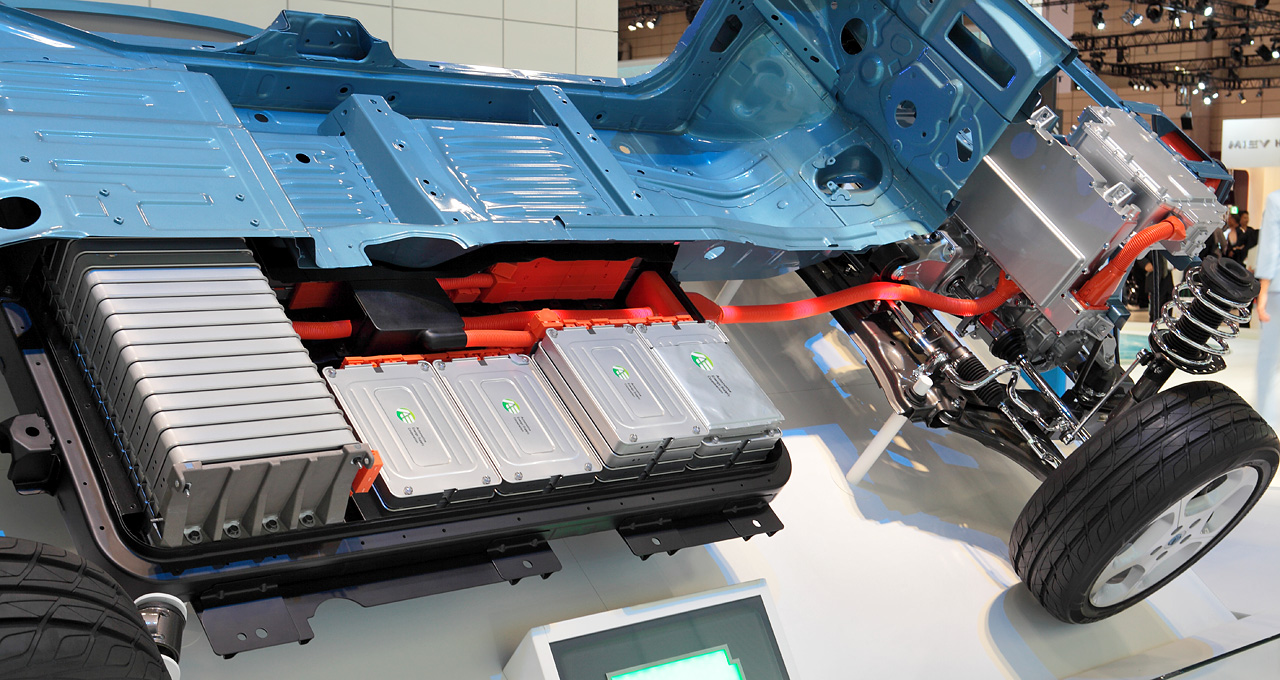
An EV battery stores energy chemically and releases it as lithium ions move between a cathode and an anode through an electrolyte, creating the electric current that drives the motor. Thousands of these lithium-ion cells are wired into modules and then a pack, managed by electronics that control charging speed, temperature and the car's range.
Almost every mass-market electric car on the road today, from city hatchbacks to pickup trucks, is powered by a lithium-ion battery pack. The same basic chemistry that runs a laptop or phone battery is scaled up, reinforced and electronically managed to move a vehicle weighing well over a tonne.
The four parts inside every cell
The U.S. Department of Energy describes a battery as two electrical terminals, the cathode and the anode, separated by a chemical material called the electrolyte. According to the vehicle-information site GreenCars, in a lithium-ion cell the cathode is typically made from materials such as lithium iron phosphate or nickel manganese cobalt, the anode is typically made from graphite, and a thin separator sits between the two electrodes to stop them from touching directly.
Charging and discharging: where the current comes from
According to the Department of Energy, electricity is stored by moving electrons from the cathode to the anode, which raises the chemical potential energy and charges the battery. When the car is driven, that flow reverses: electrons move from the anode back to the cathode through an external circuit, converting the stored chemical energy into the electric current that reaches the motor. Lithium ions travel through the electrolyte in the opposite direction to the electrons, keeping the charge balanced on each side.
The vehicle itself adds supporting hardware around this chemistry. The Department of Energy's Alternative Fuels Data Center notes that a charge port lets the car connect to an external power source, an onboard charger converts the incoming alternating current into the direct current the battery needs, and a power electronics controller regulates how much energy flows from the pack to the electric traction motor that turns the wheels.
From a single cell to a full battery pack
A single lithium-ion cell cannot power a car on its own. As the vehicle-information site GreenCars explains, an EV battery contains hundreds or thousands of individual cells that are first organized into modules, which are then combined into the complete battery pack fitted under the vehicle's floor.
Different chemistries, different trade-offs
Not all EV batteries use the same recipe. The nonprofit research group RMI notes that the two most common lithium-ion chemistries in electric cars are NMC (nickel manganese cobalt oxide) and LFP (lithium iron phosphate), and that there is no single "best" chemistry for every vehicle; each presents different trade-offs on performance and safety. GreenCars similarly lists lithium iron phosphate and nickel manganese cobalt as the two main cathode materials used today.
Charging speed depends on the connection type
How quickly a battery refills depends on the charging equipment used. GreenCars describes two common tiers: slower AC charging and fast DC charging.
| Charging type | Typical charging speed |
|---|---|
| Level 2 (AC) | Adds roughly 20 to 30 miles of range per hour of charging |
| DC fast charging | Can bring the battery to about 80% capacity in 20 to 40 minutes |
The electronics that keep a battery safe and durable
A battery management system (BMS) sits on top of the cells. GreenCars describes its core jobs as controlling voltage and current during charging and discharging, preventing overheating or overcharging, balancing power across individual cells, and extending the battery's working life while preserving safety. The Department of Energy's Alternative Fuels Data Center adds that lithium-ion batteries are chosen for EVs for their high energy per unit of mass and volume, high power-to-weight ratio, strong energy efficiency and long service life compared with older options such as nickel-metal hydride or lead-acid batteries.
Why this matters as EV sales grow
Battery technology sits at the center of the current wave of EV adoption. The International Energy Agency's Global EV Outlook 2026 reports that global electric car sales passed 20 million in 2025, about one in four new cars sold worldwide that year, up 20% from 2024. Battery electric vehicles, as opposed to plug-in hybrids, made up 65% of those electric car sales in 2025. The agency also projects that the number of electric car models on sale worldwide could exceed 1,100 in 2026, based on recent manufacturer announcements.
The IEA also found that China, Europe and the United States remain the three largest EV markets: Chinese buyers accounted for about 60% of global electric car sales in 2025, Europe's electric car sales rose more than 30% to 4.2 million units, and U.S. sales reached roughly 1.5 million, about 10% of that market, which the IEA linked to shifting policy support.
Questions
- What are the main parts of an EV battery?
- Each lithium-ion cell has a cathode, an anode, an electrolyte and a separator, according to the U.S. Department of Energy and GreenCars. Many cells are grouped into modules, and the modules are combined into the full battery pack, as GreenCars explains.
- What is the difference between NMC and LFP batteries?
- NMC (nickel manganese cobalt oxide) and LFP (lithium iron phosphate) are the two most common lithium-ion chemistries used in EVs today, according to RMI, which notes each has different trade-offs on performance and safety rather than one being universally best.
- How fast can an EV battery be recharged?
- Speed depends on the equipment: GreenCars reports that Level 2 AC charging typically adds about 20 to 30 miles of range per hour, while DC fast charging can bring a battery to around 80% capacity in 20 to 40 minutes.
- What does a battery management system do in an EV?
- According to GreenCars, the battery management system controls voltage and current during charging and discharging, prevents overheating or overcharging, balances power across cells, and helps extend battery life and safety.
- How big is the global EV market becoming?
- The International Energy Agency's Global EV Outlook 2026 reports that electric car sales exceeded 20 million worldwide in 2025, about a quarter of all new car sales, and projects that the number of electric car models on sale could exceed 1,100 in 2026.
Sources
- U.S. Department of Energy — DOE Explains...Batteries
- Alternative Fuels Data Center (U.S. DOE) — How Do All-Electric Cars Work?
- Alternative Fuels Data Center (U.S. DOE) — Batteries for Electric Vehicles
- Alternative Fuels Data Center (U.S. DOE) — All-Electric Vehicles
- RMI — EV Batteries 101: The Basics
- GreenCars — How EV Batteries Work
- IEA — Trends in electric cars, Global EV Outlook 2026
This piece was prepared with artificial intelligence and passed an automated source check before publication. If you see an error, ask for a correction. Request a correction or reply · How we make this
Related

CarsGuide
Seasonal Car Maintenance: A Step-by-Step Guide as Winter Approaches
Shifting weather is the biggest trigger for breakdowns, and most of the risk comes down to four systems: battery, tires, fluids and visibility. Checking these before cold weather sets in — based on guidance from the Car Care Council and AAA — can prevent the most common winter roadside failures.

CarsArticle
Sebastien Loeb's New Supercar Is a Lamborghini, Not a French Brand
Nine-time World Rally Champion Sebastien Loeb has taken delivery of a Lamborghini Temerario, a 920-horsepower hybrid supercar starting around €310,000. The choice stands out because Loeb built his motorsport career with French manufacturers Citroën and Peugeot, not with an Italian marque.

CarsArticle
Manual vs Automatic Transmission: What to Consider Before You Buy
Automatic transmissions now dominate new-car sales, with manuals making up less than 1% of the US market since 2021, according to EPA data. The right choice still depends on driving conditions, maintenance costs, licence rules and how much control a driver wants over gear changes.
CarsArticle
How Automatic Transmissions Work: Torque Converters, DCTs, CVTs and What's Next
Automatic transmissions change gear ratios without driver input using one of three main designs: torque-converter automatics, dual-clutch transmissions, or continuously variable transmissions. Each uses different hardware to connect the engine to the wheels, and automakers are now adapting the designs for hybrid power as interest in manual transmissions also ticks up in a handful of models.