Science · Article
How Earthquakes Form: Plate Tectonics, Stress and Seismic Waves Explained
Published:
In brief
Earthquakes happen when stress that has built up for years, decades or centuries along a locked fault finally overcomes friction and the rock suddenly slips. That slip releases stored energy as seismic waves, which radiate outward and shake the ground. The U.S. Geological Survey (USGS) and Caltech describe this as a continuous cycle driven by the slow motion of Earth's tectonic plates.
Earth's crust is a moving puzzle
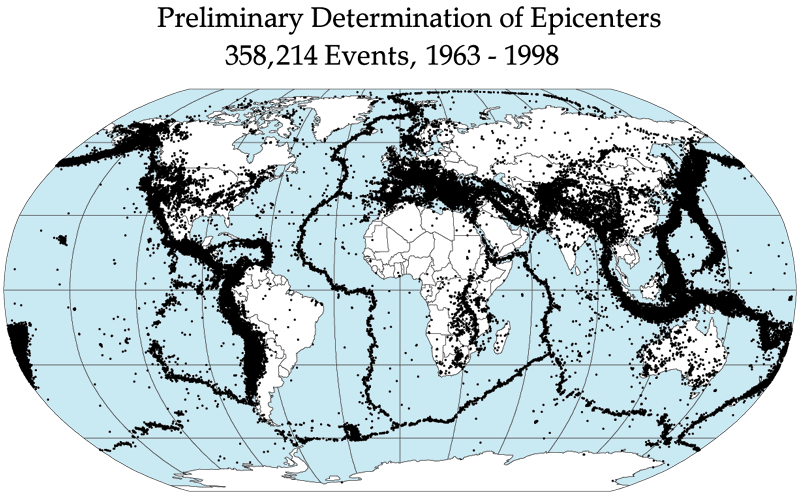
According to the U.S. Geological Survey (USGS), Earth's outer shell is broken into large pieces called tectonic plates that fit together like a puzzle. These plates are constantly, slowly moving — sliding past, over, or under one another. Most of the planet's earthquakes occur at the boundaries where these plates meet, because that is where faults — fractures in the crust — concentrate.
The plates themselves rarely move smoothly. USGS explains that friction at a fault's edges causes the rock to stick, even while the rest of the plate keeps moving. This mismatch is the starting point of every tectonic earthquake.
How stress accumulates along a fault
While a fault is locked by friction, the surrounding crust bends and deforms elastically, like a spring under tension. According to USGS, this stress is stored in the rock while the fault remains locked. The longer the fault stays locked, the more strain accumulates — this can happen over years in some zones or over centuries in others.
An earthquake is caused by a sudden slip on a fault.
USGS gives California's San Andreas Fault as a working example of this process. The Pacific Plate moves northwest relative to the North American Plate at roughly two inches (about 5 cm) per year, USGS says, and the fault itself stretches more than 650 miles (about 1,050 km) and extends more than 10 miles (16 km) deep. Along some sections the plates creep steadily and produce frequent small tremors; along others they stay locked for long stretches, building up the strain that is eventually released in a large earthquake.
The moment of rupture: hypocenter and epicenter
When accumulated stress finally exceeds the friction holding a fault together, the rock ruptures and releases the stored energy outward as seismic waves, according to USGS. The point underground where the rupture starts is the hypocenter; the point on the surface directly above it is the epicenter — the location usually reported in news coverage.
USGS notes that smaller tremors called foreshocks can precede the main rupture, while aftershocks — smaller quakes along the same fault — can continue for days to years afterward as the surrounding crust adjusts to the new stress distribution.
How the released energy travels: seismic waves
The energy released at the hypocenter spreads outward in several distinct wave types, each with different speed and behavior. USGS compares the spreading pattern to ripples on a pond, while Caltech's Science Exchange groups the waves into two broad classes: body waves, which travel through Earth's interior, and surface waves, which travel along the ground.
| Wave type | Also travels through | Ground motion | Arrival order |
|---|---|---|---|
| P wave (primary) | Solids, liquids and gases | Compresses and expands rock in the direction of travel | First to arrive |
| S wave (secondary) | Solids only | Shears rock side to side, perpendicular to travel direction | Arrives after P waves |
| Surface waves (Love and Rayleigh) | Along the ground surface only | Rolling or side-to-side motion, similar to ocean waves | Arrive last, but cause most damage |
USGS likens the P-wave/S-wave gap to the delay between seeing lightning and hearing thunder: the greater the time between the two arrivals at a seismic station, the farther away the earthquake occurred. Caltech notes that surface waves — Love waves and Rayleigh waves — arrive last but are typically the most destructive because they carry more energy near the surface, where buildings and infrastructure sit.
Where and how deep earthquakes occur
USGS states that earthquakes occur within the crust or upper mantle, in a depth range from the surface down to about 800 kilometers (roughly 500 miles). Caltech's Science Exchange reports that about 80% of the world's largest earthquakes occur along the circum-Pacific seismic belt, often called the "Ring of Fire," which traces plate boundaries around the Pacific Ocean.
Not every earthquake is tectonic in origin. Caltech's Science Exchange also lists volcanic earthquakes, collapse earthquakes, and explosion-related earthquakes as other recognized categories, and notes that activities such as fracking or wastewater disposal have occasionally been linked to smaller induced seismic events in some regions.
How scientists measure what happened
Because faults are usually too deep to observe directly, USGS explains that seismologists rely on seismograph recordings instead. A short, wiggly line on a seismogram indicates a small earthquake, while a long, wiggly line indicates a larger one — the length of the wiggle relates to the size of the fault that ruptured, and its amplitude relates to how far the rock slipped.
- Earthquakes start when stress on a locked fault overcomes the friction holding it in place (USGS).
- The hypocenter is the underground point of rupture; the epicenter is the point on the surface directly above it (USGS).
- P waves arrive first and compress rock in the direction of travel; S waves arrive second and move only through solids (USGS, Caltech).
- Surface waves — Love and Rayleigh waves — arrive last but typically cause the most structural damage (Caltech).
- About 80% of the largest earthquakes occur along the circum-Pacific "Ring of Fire" (Caltech).
Questions
- What actually triggers an earthquake?
- According to USGS, an earthquake is triggered when accumulated stress on a locked fault finally exceeds the friction holding the two sides together, causing a sudden slip that releases stored elastic energy as seismic waves.
- What is the difference between P waves and S waves?
- USGS explains that P waves (primary waves) arrive first and compress and expand rock in the direction they travel, moving through solids, liquids and gases. S waves (secondary waves) arrive after P waves, move only through solid rock, and shake the ground side to side, perpendicular to the direction of travel.
- Why do surface waves cause the most damage?
- Caltech's Science Exchange notes that surface waves — Love waves and Rayleigh waves — travel along the ground rather than through Earth's interior and arrive last, but they typically produce the strongest shaking at the surface, where buildings and infrastructure are located.
- What is the difference between a hypocenter and an epicenter?
- USGS defines the hypocenter as the underground point where a fault ruptures and the epicenter as the point on Earth's surface directly above the hypocenter — the location typically reported for an earthquake.
- How deep underground do earthquakes occur?
- USGS states that earthquakes occur within the crust or upper mantle, in a depth range extending from the surface down to about 800 kilometers (roughly 500 miles).
Sources
This piece was prepared with artificial intelligence and passed an automated source check before publication. If you see an error, ask for a correction. Request a correction or reply · How we make this
Related

ScienceGlossary
Weather vs. Climate: The Key Difference, Defined
Weather is the atmospheric condition at a specific place and moment — rain, wind, or temperature right now. Climate is the average of those weather patterns over a long period, usually 30 years or more, according to NASA and NOAA. The difference is essentially one of timescale, not of the phenomena themselves.

ScienceArticle
Why the World Is Scrapping Leap Seconds From 2027
On 15 October 2026, the General Conference on Weights and Measures (CGPM) voted in Versailles to stop adding "leap seconds" to world clocks from 20 May 2027. The 53-year-old practice of occasionally inserting an extra second into Coordinated Universal Time (UTC) is being replaced by a system that lets clock time drift from Earth's actual rotation for up to an hour before any correction is needed.
ScienceArticle
Astronomers Identify the First Green Star: How a White Dwarf's Chemistry Sets Its Color
Astronomers at the University of Warwick say the white dwarf WD J1330+6435, located about 284 light-years away, is the first star ever credibly reported to look green to the human eye. The color comes from sodium absorbing yellow, orange and red light in its unusually dense atmosphere after it swallowed rocky debris from its own planetary system. The findings, published in the journal RAS Techniques and Instruments, also mapped other unexpected white dwarf colors, including pink, purple, cyan and yellow.
ScienceNews
Magnitude 6.9 Earthquake Hits Russia's Kamchatka Peninsula; No Tsunami Threat
A strong earthquake struck off Russia's Kamchatka Peninsula on October 16, 2026. The US Geological Survey measured it at magnitude 6.9; the European-Mediterranean Seismological Centre initially put the preliminary magnitude at 7.0 before revising it to 6.9, matching the USGS figure. Authorities in Hawaii and Japan said there was no tsunami threat, though Japan's Meteorological Agency briefly and mistakenly warned of a magnitude 9.9 quake before retracting it eight minutes later.