History · Article
Saint Francis of Assisi: 800th anniversary of his death marked in Assisi and Italy
Published:

In brief
October 4, 2026 marks the feast day of Saint Francis of Assisi and the 800th anniversary of his death in 1226. The Vatican, Italy and Franciscan communities are marking the occasion with a public display of his relics, commemorative events in Assisi, and joint postage stamps, reflecting his continuing influence on themes of peace, poverty and care for the environment.
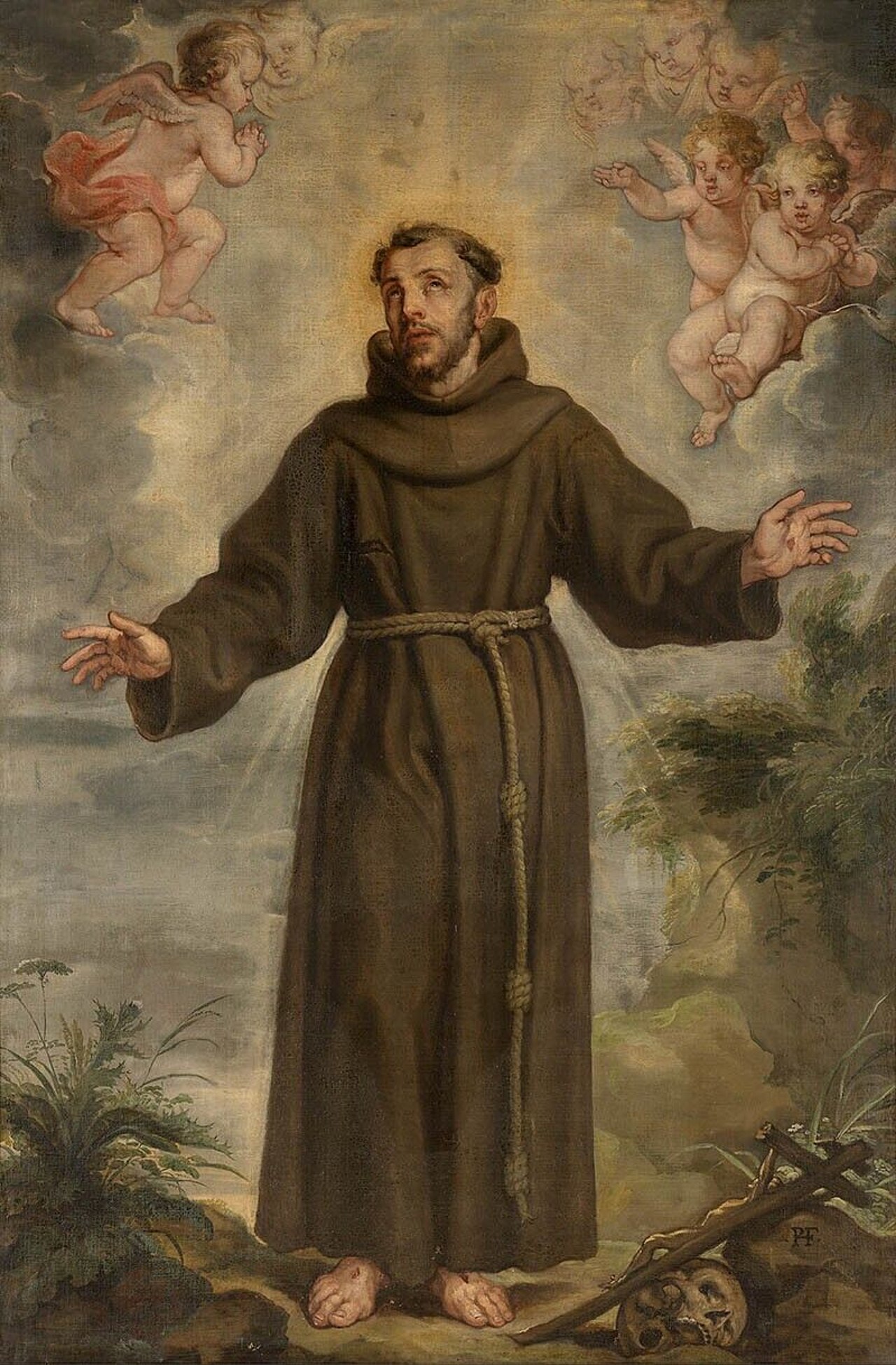
Saint Francis of Assisi died on the night of October 3 to 4, 1226, in the Porziuncola chapel near Assisi, in the Italian region of Umbria. Eight hundred years later, October 4, 2026 is being observed as both his annual feast day and the anniversary of his death, with commemorations in Italy and at the Vatican.
What is happening in 2026
As part of the 800th anniversary commemorations, the saint's remains were removed from the crypt of the Basilica of Saint Francis in Assisi and placed at the foot of the papal altar in the lower church for public veneration from February 22 to March 22, 2026, according to Vatican News — the first time his body has been displayed for an extended period. The outlet reported that the display drew between roughly 15,000 and 18,000 visitors a day, with total attendance estimated at around 370,000.
The main anniversary events were scheduled for October 3-4, 2026, in Assisi, according to EWTN News. Attendees were expected to include Italian President Sergio Mattarella, Cardinal Matteo Maria Zuppi of Bologna, and papal legate Cardinal Ángel Fernández Artime. A solemn Mass was planned for October 4, and the program included the "Transitus" ceremony that recalls Francis's final hours, plus a traditional procession at the Porziuncola. Related commemorations were set to run from September 24 to October 5.
According to EWTN News, Bishop Felice Accrocca, the newly appointed bishop of Assisi, said Francis's radical reading of the Gospel and his vision of a society built on peace and fraternity continue to draw people from many countries and cultures today.
Italy's national holiday and commemorative stamps
October 4 has been reinstated as a national holiday in Italy, according to Sky TG24. In 2026 the date falls on a Sunday, which affects payroll: employees are entitled to compensation for an "unenjoyed festivity," with simulations cited by Sky TG24 showing additional net pay of roughly 39 to 53 euros depending on contract and sector. Employers must apply the holiday even where collective labour contracts have not yet been formally updated, the outlet reported, covering sectors including retail, metalworking, crafts, professional offices and hospitality.
Italy's Ministry of Business and Made in Italy (MIMIT) presented two commemorative stamps on October 2, 2026, at the Sacred Convent of Saint Francis in Assisi, in a joint issuance with Vatican City State, the Republic of San Marino and the Sovereign Military Order of Malta. According to the ministry's statement, the State Printing Office produced 200,025 stamps featuring a detail from a Giotto fresco and 300,027 stamps depicting the Canticle of the Creatures in a modern illustrative style.
San Francesco rappresenta l'identità italiana nella sua espressione più alta.
The roots of his lasting influence
Francis founded the Franciscan religious order after renouncing his family's wealth, and he is credited with the Canticle of the Creatures, a poem praising the sun, moon, water and other elements of nature as siblings within a shared creation.
That theme was drawn on directly by Pope Francis, who took the saint's name upon his election and titled his 2015 encyclical on the environment and poverty "Laudato Si'," a phrase from the Canticle meaning "Praise be to you." In the encyclical, published on the Vatican's official website, Francis referred to the medieval friar as a patron of those who study and work in ecology, and presented him as a model for what the document calls "integral ecology," linking care for nature to concern for the poor.
Key facts
- Died: night of October 3–4, 1226, at the Porziuncola, near Assisi, Italy
- Feast day / anniversary observed: October 4
- Relic public display: February 22 – March 22, 2026, lower church of the Basilica of Saint Francis
- 2026 Italian commemorative stamps: 200,025 (Giotto fresco design) and 300,027 (Canticle of the Creatures design)
Questions
- Why is October 4 significant for Saint Francis of Assisi?
- October 4 is his annual feast day and, in 2026, also marks 800 years since his death on the night of October 3-4, 1226, according to Vatican News and EWTN News.
- Is October 4 a public holiday in Italy in 2026?
- Yes. Sky TG24 reported that October 4 has been reinstated as a national holiday; because it falls on a Sunday in 2026, workers are entitled to extra compensation for the unenjoyed festivity.
- Why is Saint Francis linked to environmentalism?
- His Canticle of the Creatures, which praises elements of nature as siblings, inspired Pope Francis's 2015 encyclical Laudato Si', published on the Vatican's official site, which describes Francis as a patron of those who study and work in ecology.
- Were Saint Francis's remains displayed to the public in 2026?
- Yes. Vatican News reported his remains were moved from the crypt of the Basilica of Saint Francis to the foot of the papal altar in the lower church for public veneration from February 22 to March 22, 2026.
How the world is telling it
- ItalianItalian outlets such as Sky TG24 focus on the practical, domestic impact of October 4 as a reinstated national holiday, detailing payroll effects for workers, while the Italian government's MIMIT ministry statement frames Saint Francis as a symbol of national identity through the joint commemorative stamp issuance with the Vatican, San Marino and the Order of Malta.
Sources
- Sky TG24 — 4 ottobre, festa nazionale: cosa cambia in busta paga
- MIMIT (Italian Ministry of Business and Made in Italy) — press release on commemorative stamps for 800 years of Saint Francis
- Vatican News — Remains of St. Francis to be visible for veneration in Assisi
- EWTN News — Assisi to welcome thousands of pilgrims for 800th anniversary of St. Francis' death
- Vatican.va — Laudato Si' encyclical of Pope Francis (24 May 2015)
This piece was prepared with artificial intelligence and passed an automated source check before publication. If you see an error, ask for a correction. Request a correction or reply · How we make this
Related

HistoryNews
Expedition reaches Nikumaroro to search for Amelia Earhart's lost plane
A 16-to-17-member expedition led by the Archaeological Legacy Institute and Purdue University is approaching the remote Pacific atoll of Nikumaroro to inspect a sonar/satellite anomaly called the "Taraia Object," which researchers say could be wreckage of Amelia Earhart's Lockheed Electra 10-E. The team departed Tarawa, Kiribati on October 7, 2026 and expected to reach the atoll around midday on October 12 local time, after which it plans about five days of diving, dredging and remote-sensing work.

HistoryArticle
The Renaissance: How Art and Science Reshaped Europe, 14th–17th Centuries
The Renaissance was a cultural and intellectual movement that began in 14th-century Florence and spread across Europe by the 17th century, reviving classical learning and reshaping art, science, and education. It bridged the medieval and modern worlds through humanism, new artistic techniques such as linear perspective, and scientific breakthroughs including the heliocentric model of the solar system.

HistoryArticle
The Crusades Explained: Medieval Religious Wars, Causes and Lasting Impact
The Crusades were a series of religious wars fought mostly between 1095 and 1291, in which Western European Christians tried to capture or defend Jerusalem and other sites from Muslim rule. They began after the Byzantine emperor asked for Western military help and Pope Urban II turned that appeal into a holy war. Their political, economic and religious effects still shape relations between the Christian and Muslim worlds today.

HistoryArticle
The Industrial Revolution: Innovations, Social Change and Global Reach
The Industrial Revolution was the shift from hand production and farming to machine-based manufacturing, beginning in Britain around the 1760s and spreading worldwide over the next century. It was driven by innovations such as the steam engine and new textile machinery, and it reshaped where people lived, how they worked, and how goods were made and traded.