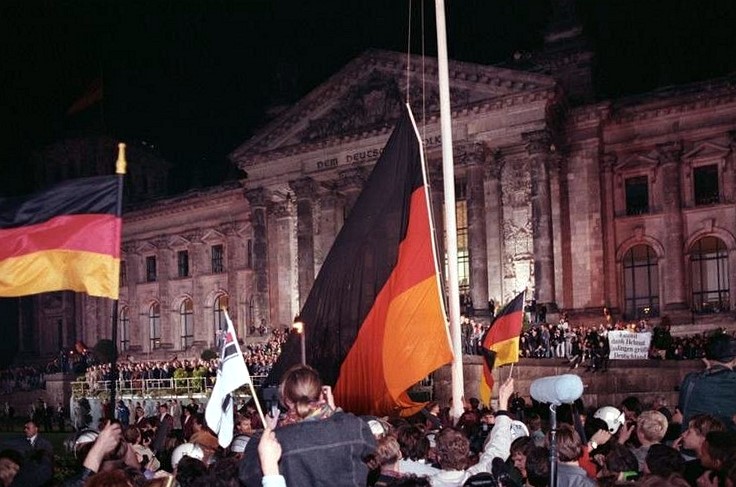
Every October 3, Germany marks the Tag der Deutschen Einheit — German Unity Day — the only holiday observed nationwide across all 16 federal states. It commemorates a specific legal act: the moment in 1990 when the German Democratic Republic (East Germany, GDR) ceased to exist as a separate state and its territory joined the Federal Republic of Germany (West Germany, FRG), according to the German government's citizen portal deutschland.de and Wikipedia's sourced account of the reunification process.
Why October 3, not November 9?
The more emotionally charged date in German history is November 9, 1989, when the Berlin Wall fell after weeks of mass protests in East Germany. Yet that date was ruled out as a national holiday, according to Wikipedia's sourced account, because November 9 also marks Kristallnacht, the 1938 Nazi pogrom against Jewish communities — a coincidence officials judged inappropriate for a celebratory holiday.
Instead, East Germany's freely elected parliament, the Volkskammer, voted on August 22–23, 1990, with 294 deputies in favor, 62 against and 7 abstaining out of 363 votes cast, to set October 3 as the date on which the GDR would accede to the Federal Republic under Article 23 of West Germany's then-constitution, according to Wikipedia's account of the vote. That accession took legal effect on October 3, 1990, making it the operative date of reunification.
From parliamentary vote to legal unity
With the Volkskammer's vote in effect, East Germany's states formally joined the Federal Republic of Germany on October 3, 1990. The holiday replaced two earlier, now-defunct observances: West Germany's June 17 "Day of German Unity," which had been a national holiday since 1954, and East Germany's own national day, Republic Day, held each October 7 until 1989, according to Wikipedia's account.
How the day is marked today
The centerpiece of the modern holiday is a Bürgerfest, a multi-day citizens' festival with concerts, exhibitions and official speeches, held each year in whichever state currently holds the rotating presidency of the Bundesrat, Germany's federal upper chamber. According to the Bundesrat's own schedule, the order in which states take the presidency is fixed through 2041.
In 2025, the 35th-anniversary festival was hosted in Saarbrücken, the capital of Saarland, which then held the Bundesrat presidency. Saarland handed the presidency to Bremen, and Bremen hosts the 2026 festival in its city centre from October 2–4 under the motto "Viele Stärken – ein Land" ("Many Strengths, One Country"), with Bremen's mayor, Andreas Bovenschulte, serving as Bundesrat president, according to the Bundesrat and deutschland.de.
Still two Germanies in the data?
More than three decades on, official statistics still show measurable gaps between the former East and West. According to calculations based on official state and Destatis (Germany's Federal Statistical Office) data for 2025, GDP per capita in the eastern states stood at roughly 72% of the western level when Berlin is excluded, or about 80% when Berlin is included. Average gross monthly wages for full-time employees were €4,121 in the east versus €4,961 in the west — about 83% of the western level.
A 2025 report by Elisabeth Kaiser, the federal government's Commissioner for East Germany, titled "35 Years: Growing Up in Unity?", examined the first generation to have grown up entirely after reunification. It found some indicators have converged almost completely — female employment rates were 74.4% in the east versus 74.1% in the west — while other gaps, including in wealth and leadership representation, remain large. Kaiser said that the region a person grows up in, "der Osten" included, still shapes identities and influences life paths.
East–West Germany: selected 2025 indicators| Indicator | Eastern Germany | Western Germany | Source |
|---|
| GDP per capita (excl. Berlin) | ~72% of western level | 100% (reference) | Arbeitskreis VGRdL / Destatis, 2025 data, published March 2026 |
|---|
| Average gross monthly wage (full-time) | €4,121 | €4,961 | Destatis wage statistics, 2025 data, published April 2026 |
|---|
| Female employment rate | 74.4% | 74.1% | Federal Commissioner for East Germany, 2025 report |
|---|
A holiday built on consensus, not conquest
Unlike many national days that mark independence won through conflict, German Unity Day commemorates a process completed through a parliamentary vote rather than war. That origin — a peaceful revolution in the GDR in 1989 followed by legal accession in 1990 — is why German officials and historians typically describe the day as marking both an ending of Cold War division and the legal completion of a process that began with the Berlin Wall's fall, rather than a single dramatic event.
This piece was prepared with artificial intelligence and passed an automated source check before publication. If you see an error, ask for a correction. Request a correction or reply · How we make this