On 15 October 2026, the General Conference on Weights and Measures (CGPM) voted to stop inserting leap seconds into Coordinated Universal Time (UTC), effective 20 May 2027. The change means UTC will run continuously and be allowed to drift up to one hour from Earth's actual rotation before any future correction, instead of the one-second adjustments used since 1972.
The General Conference on Weights and Measures (CGPM), the intergovernmental body that oversees global measurement standards, voted on 15 October 2026 at its 28th meeting in Versailles, France, to end the practice of adding leap seconds to Coordinated Universal Time (UTC). The resolution passed by majority vote among representatives of the organisation's member states, according to Euronews and Scientific American.
The change takes effect on 20 May 2027 — World Metrology Day. From that date, UTC will run continuously, without the occasional one-second insertions that have periodically realigned atomic clock time with the slightly irregular rotation of the Earth since 1972.
What a Leap Second Was and Why It Existed
According to Wikipedia's entry on the subject, a leap second is a one-second adjustment that has been applied to UTC since 1972 to keep it within 0.9 seconds of UT1, the time scale based on the Earth's actual rotation. Atomic clocks that define International Atomic Time (TAI) run at a perfectly constant rate, but the planet's rotation varies irregularly, so without correction, clock time and solar time would slowly diverge.
Between 1972 and 2016, 27 leap seconds were added, always on 30 June or 31 December, with the most recent inserted at the end of 2016. The adjustments were announced irregularly, roughly every 21 months on average, whenever the International Earth Rotation and Reference Systems Service determined one was needed.
Why Scientists Wanted to Scrap It
Leap seconds caused repeated technical problems. Wikipedia's article documents outages tied to the 2012 leap second affecting Reddit's Cassandra database, Mozilla's Hadoop systems, Qantas and various Linux-based services; GPS receivers and network time protocol servers have also been affected. Companies such as Google and Amazon adopted a 'leap smear' workaround, spreading the extra second gradually over hours rather than inserting it all at once.
The decisive factor in 2026, however, was the risk of a negative leap second — removing a second rather than adding one — which has never been implemented. Scientific American reported that Earth's rotation has recently sped up, raising the possibility that a negative leap second could have been required as early as 2029. Nick Stamatakos, head of the Earth Orientation Department at the U.S. Naval Observatory, was quoted saying 'avoiding negative leap seconds is a very big driver' of the decision, while Noël Dimarcq, president of a BIPM consultative committee, remarked, 'After 30 years of debates, we are ready.'
Avoiding negative leap seconds is a very big driver.
— Nick Stamatakos, quoted by Scientific American
How the New System Works
Instead of one-second corrections, the new rules allow the gap between UTC and UT1 to grow to as much as 3,600 seconds — one hour — before any adjustment, described as a 'leap hour,' would be needed. Scientific American reported that, at current rates of divergence, such a correction is not expected for more than 1,000 years. Euronews described the change as essentially precautionary, saying any correction based on this new tolerance remains far off.
The International Bureau of Weights and Measures (BIPM), the organisation that coordinates UTC on behalf of its member states, implements the policy that the CGPM sets, according to Euronews and Scientific American's reporting on the vote.
Background: The 2022 Resolution
The decision builds on a resolution the CGPM passed on 18 November 2022, which directed that the maximum permitted difference between UTC and UT1 be increased 'in, or before, 2035.' The October 2026 vote set the firm effective date of 20 May 2027 and fixed the one-hour maximum divergence, according to Wikipedia's summary of the resolution history.
Who Is Affected
Scientific American reported that GPS and other satellite navigation systems, telecommunications networks, computers, phones, ships and aircraft all rely on precise time standards and will be affected by the switch to continuous UTC. Astronomy and geodesy applications that depend on the Earth's rotational position will need to track the growing UTC–UT1 gap separately rather than relying on leap-second corrections, per Euronews's reporting.
Old vs. New UTC Timekeeping Rules
Feature
Pre-2027 system
Post-2027 system
Correction type
One-second leap second
One-hour 'leap hour' (if ever needed)
Max UTC–UT1 gap allowed
0.9 seconds
3,600 seconds (1 hour)
Corrections applied (1972–2016)
27 leap seconds inserted
None yet under new system
Next correction expected
Irregular, roughly every 21 months historically
Not expected for over 1,000 years, according to an estimate cited by Scientific American
Effective date of change
N/A
20 May 2027
Questions
When do leap seconds officially end?
Continuous UTC, without leap-second insertions, takes effect on 20 May 2027, following the CGPM's vote on 15 October 2026.
Who decided to abolish leap seconds?
The General Conference on Weights and Measures (CGPM), the intergovernmental body that sets global measurement standards, approved the change by majority vote at its 28th meeting in Versailles.
Why were leap seconds causing problems?
Past leap-second insertions triggered software outages at companies including Reddit and Mozilla and affected systems such as Qantas's and various Linux servers; the deciding risk in 2026 was the possibility of an untested 'negative' leap second as Earth's rotation sped up.
What replaces the leap second?
UTC will be allowed to drift from Earth-rotation-based UT1 time by up to one hour before any correction — a 'leap hour' — is applied, a change not expected to be needed for more than 1,000 years according to Scientific American.
How many leap seconds have there been in total?
Twenty-seven leap seconds were added to UTC between 1972 and 2016, with the most recent on 31 December 2016; none have been added since.
This piece was prepared with artificial intelligence and passed an automated source check before publication. If you see an error, ask for a correction. Request a correction or reply · How we make this
The General Conference on Weights and Measures voted on 15 October 2026 to stop adding leap seconds to Coordinated Universal Time (UTC), making the time standard continuous from 20 May 2027. The decision, adopted as Resolution 5 at the BIPM's 28th meeting in Versailles, France, replaces the one-second correction used since 1972 with a tolerance of up to one hour.
Japan's Meteorological Agency (JMA) issued and then withdrew, within about eight to twelve minutes, an emergency warning for a magnitude-9.9 earthquake on October 16, 2026. The actual quake, centred off Russia's Kamchatka Peninsula, was later confirmed by seismologists at magnitude 6.9, with JMA blaming a data-processing error rather than a cyberattack.
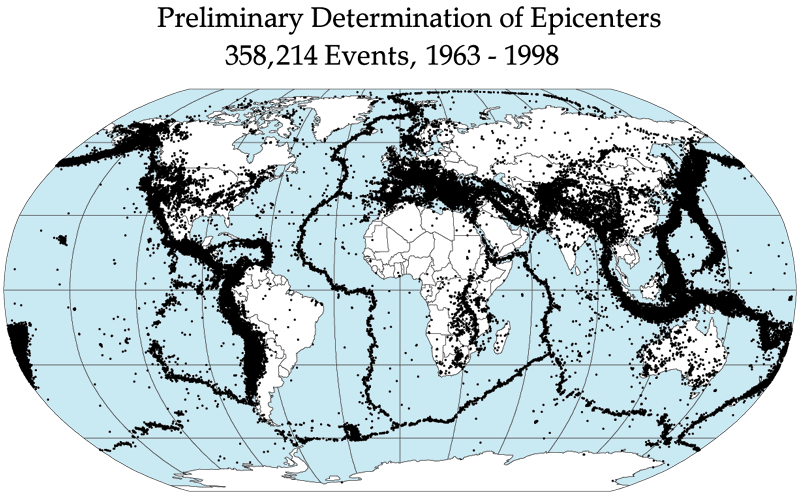
Earthquakes happen when stress that has built up for years, decades or centuries along a locked fault finally overcomes friction and the rock suddenly slips. That slip releases stored energy as seismic waves, which radiate outward and shake the ground. The U.S. Geological Survey (USGS) and Caltech describe this as a continuous cycle driven by the slow motion of Earth's tectonic plates.
Weather is the atmospheric condition at a specific place and moment — rain, wind, or temperature right now. Climate is the average of those weather patterns over a long period, usually 30 years or more, according to NASA and NOAA. The difference is essentially one of timescale, not of the phenomena themselves.