Stargazing does not require a telescope or technical training to get started. According to NASA, the most reliable way to begin is to find one bright, recognizable star pattern and use it as an anchor for locating everything else, including the direction of true north.
Why constellations are useful, not just decorative
The International Astronomical Union (IAU) formally adopted 88 constellations at its General Assembly in Rome in 1922, according to the IAU archive. Precise boundaries for these 88 regions were approved at the IAU's 1928 Leiden assembly and published in 1930. The IAU archive notes this process turned constellations from loose, artistic star patterns into formally defined regions of sky, giving every star and object in the sky an unambiguous address for astronomers worldwide.
Step 1: Get your eyes and your bearings ready
- Pick the darkest spot you can reach, away from streetlights and building glare.
- Give your eyes about 15 minutes to adjust to the dark before trying to spot fainter stars.
- Face toward the direction you plan to use as your starting reference — north in the Northern Hemisphere, south in the Southern Hemisphere.
- Start with one easy-to-recognize pattern rather than trying to learn many constellations at once.
Step 2: Finding north using the Big Dipper and Polaris
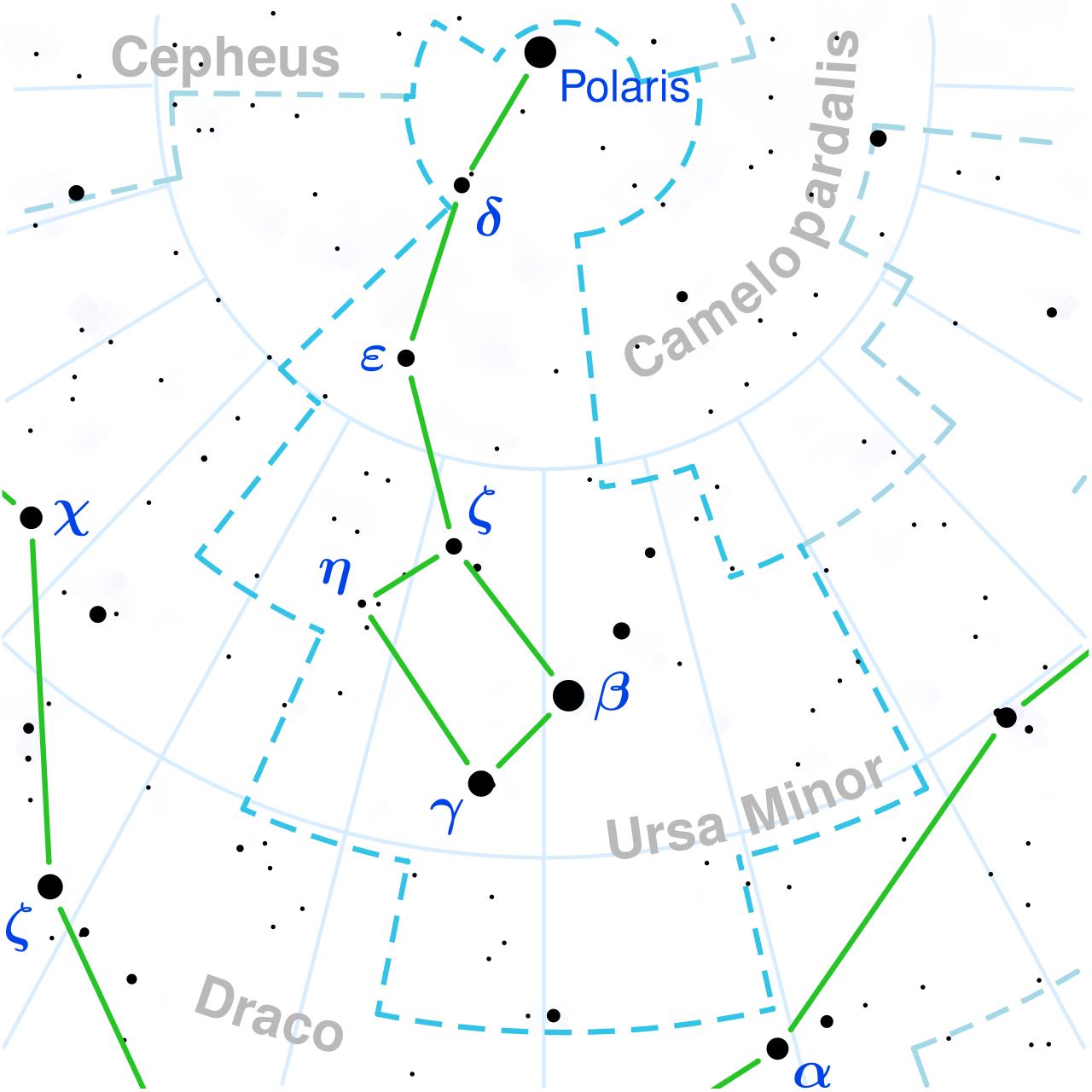
In the Northern Hemisphere, NASA's Science division explains that the simplest landmark is the Big Dipper, a group of seven bright stars shaped like a ladle. "The two stars on the end of the Dipper's 'cup' point the way to Polaris," NASA states. Those two stars form an imaginary line that, when extended outward, leads to Polaris, also known as the North Star.
Polaris itself is not the brightest star in the sky, but NASA notes it is easy to spot even from a city, because it is usually not hard to make out despite not outshining other stars. What makes it valuable for orientation is its position: it sits close to the north celestial pole, the point in the sky aligned with Earth's rotational axis. Because of that alignment, NASA explains, Polaris moves only slightly over a 24-hour period, tracing a very small circle around the pole, which makes it a dependably fixed marker of north for observers anywhere in the Northern Hemisphere.
NASA also points out that Polaris has not always held this role. Earth's axis wobbles slowly over a roughly 26,000-year cycle, so the star marking north shifts over very long timescales — Vega was the North Star about 14,000 years ago and will be again in roughly 12,000 years, according to NASA.
Step 3: Finding south using the Southern Cross
South of the equator, there is no single bright star marking the south celestial pole the way Polaris marks north. EarthSky explains that observers instead use the Southern Cross (Crux) together with two nearby bright stars, Alpha Centauri and Beta Centauri, known as the Pointer Stars.
One method described by EarthSky: draw an imaginary line through the long axis of the Southern Cross, from its top star to its bottom star, and extend it outward. Separately, draw a line bisecting the two Pointer Stars. According to EarthSky, the south celestial pole lies where those two lines intersect.
EarthSky also describes a simpler estimate: extending the long axis of the Southern Cross about four times its own length from its foot gives an approximate position for the celestial pole. A third method uses the bright star Achernar — the south celestial pole falls roughly midway between Achernar and Gacrux, the star at the head of the Southern Cross.
Step 4: Build outward from your first landmark
- Learn one anchor pattern per hemisphere before adding more.
- Use pointer stars — pairs of bright stars that "point" toward a target star or celestial pole — as a consistent technique across different constellations.
- Remember that a constellation's IAU-defined boundary covers a whole region of sky, not just the connect-the-dots shape of its named stars.
- Re-check your position occasionally; Polaris and the Southern Cross method both work because the celestial poles stay fixed relative to the horizon, while other stars appear to rotate around them over the night.
What this is useful for
Finding the celestial poles through Polaris or the Southern Cross gives a compass-free reference for true north or south, a navigational use described in EarthSky's explanation of the Southern Cross method. For stargazers, the same pointer-star technique scales up: once you can find Polaris or the south celestial pole reliably, you can use it to orient a star chart and locate other IAU-recognized constellations overhead.
Questions
- What is the easiest constellation for a beginner to find first?
- In the Northern Hemisphere, the Big Dipper is a commonly recommended starting point because its seven stars form a simple, bright ladle shape, and its two outer bowl stars point directly to Polaris, according to NASA.
- How do I find the North Star without a compass?
- Locate the Big Dipper, then draw an imaginary line through the two stars at the outer edge of its bowl and extend that line outward; it leads to Polaris, NASA explains.
- Is Polaris the brightest star in the sky?
- No. NASA states that Polaris is not the brightest star, but its fixed position near the north celestial pole makes it easy to use for orientation even though other stars outshine it.
- How do you find south if you can't see Polaris?
- South of the equator, observers use the Southern Cross along with the Pointer Stars Alpha and Beta Centauri; the intersection of a line through the Cross's long axis and a line bisecting the two Pointer Stars marks the south celestial pole, according to EarthSky.
- How many official constellations are there?
- There are 88 constellations, a number formally adopted by the International Astronomical Union in 1922, with precise sky boundaries approved in 1928 and published in 1930, per the IAU archive.
This piece was prepared with artificial intelligence and passed an automated source check before publication. If you see an error, ask for a correction. Request a correction or reply · How we make this