The Viking Age ran from the 793 raid on Lindisfarne to the 1066 Battle of Stamford Bridge, when Scandinavian seafarers raided, traded and settled from Newfoundland to the Byzantine world. This guide uses museum and archaeological sources to walk beginners through the timeline, social structure, religion, runes, ships and common myths.
What Was the Viking Age?
The Viking Age is conventionally dated from 793 to 1066. English Heritage, which now manages the Lindisfarne Priory site in Northumbria, dates the opening event to 8 June 793, when Viking raiders attacked the monastery of St Cuthbert on Lindisfarne, desecrating the church, shedding blood around the altar and destroying monastic buildings. Wikipedia's overview of the period places the conventional end around 1066, after the Battle of Stamford Bridge ended large-scale Scandinavian military ambitions in England, while noting that some scholars prefer a broader range of about 800 to 1050 CE.
Pagans have desecrated God's sanctuary, shed the blood of saints around the altar.
— Alcuin of York, writing after the 793 Lindisfarne raid, as recorded by English Heritage
Fix the timeline first: the era runs from the 793 raid on Lindisfarne to the 1066 Battle of Stamford Bridge.
Learn where Vikings came from: the homelands were in Scandinavia, with shipbuilding and craft traditions documented in present-day Denmark and Norway.
Learn the social order: Viking society was divided into jarls, karls and thralls.
Learn the belief system: gods such as Odin, Thor and Freyja, and a separate runic alphabet used mainly for memorials.
Learn how they traveled: specialised ships carried raiders, traders and settlers as far as Newfoundland and the Byzantine world.
Society and Daily Life in the Viking Age
According to Wikipedia's summary of the period, Viking society in Scandinavia was divided into three main groups: jarls, nobles or ship captains who often governed territory under emerging kings; karls, free farmers and craftspeople who made up most of the population; and thralls, enslaved people who formed the lowest tier of the social order.
Archaeological material compiled by Denmark's Viking Ship Museum indicates people of the period were on average 8 to 10 centimetres shorter than today and rarely lived past 40 or 50 years old, with skeletal remains showing frequent arthritis and dental wear but few cavities, since sugar was scarce. Clothing combined wool and linen for tunics, trousers and gowns, with leather for shoes and outerwear; men typically wore beards or mustaches, and combs made of wood or bone are among the most common objects found from the era.
Belief, Writing and Ships
Pre-Christian Viking religion centered on two groups of gods, the Aesir and the Vanir, according to Sweden's Historiska museet. Odin led the Aesir from the realm of Asgard and was said to have sacrificed one eye for wisdom; Thor, a thunder god, was known for fighting giants with his hammer; and Freyja represented love and fertility. Mythology placed these realms on the cosmic tree Yggdrasil, with the dead who did not reach the gods' halls instead crossing dark valleys to Nifelhel, the underworld ruled by Hel.
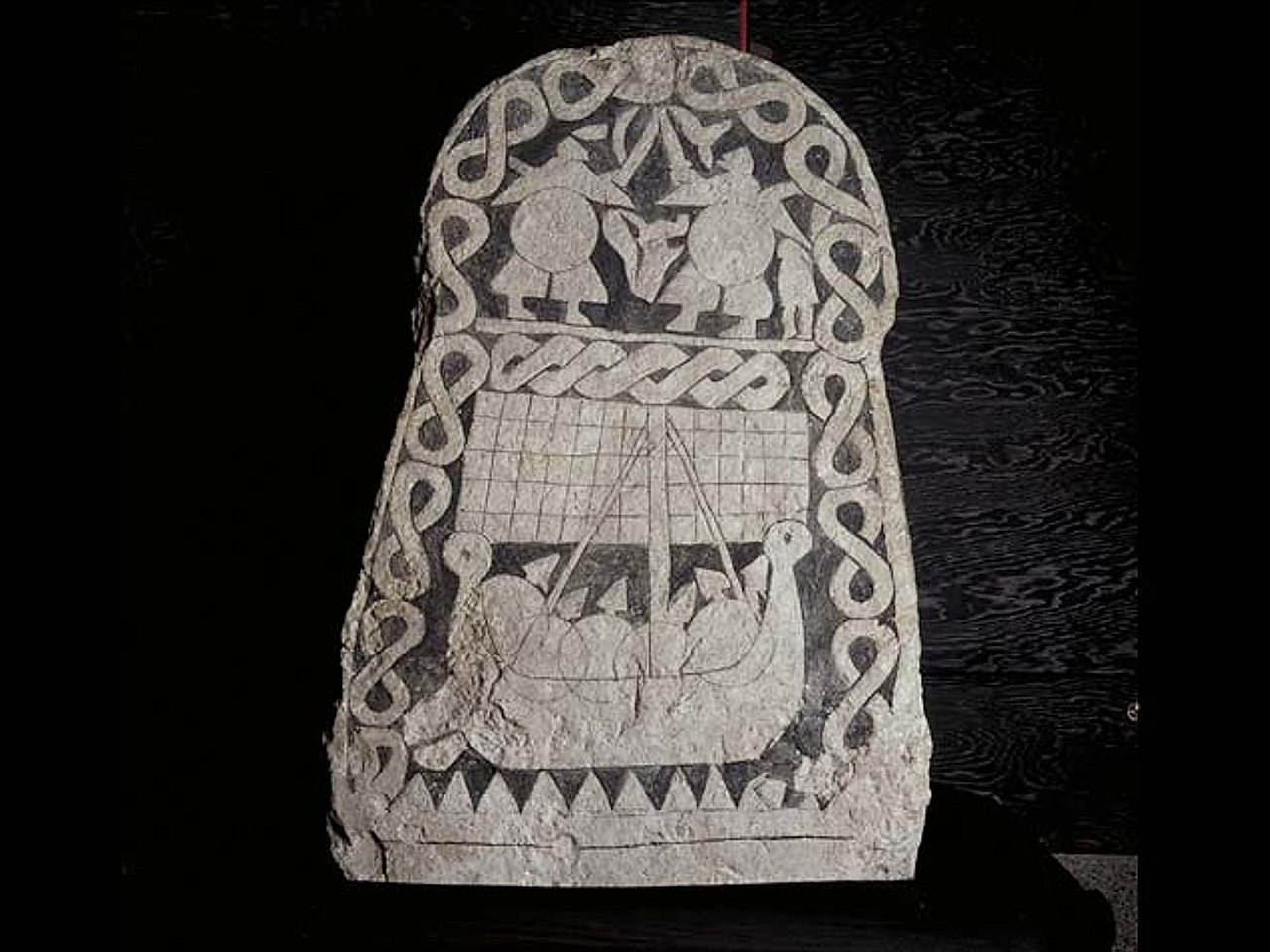
Vikings recorded names, memorials and short messages with a runic alphabet called the futhark, named after its first six letters — f, u, þ, a, r, k — according to the Viking Ship Museum in Roskilde. An older 24-letter Elder Futhark was simplified to a 16-letter Younger Futhark used during the Viking Age itself. Because runes were carved into stone, wood, bone or iron rather than written on paper, their shapes were angular; large memorial stones praising a notable man or woman were especially common, and runic inscriptions have been found as far from Scandinavia as England, Greece, Turkey, Russia and Greenland.
Movement depended on specialised wooden ships. The Viking Ship Museum's collection of five vessels recovered from Roskilde Fjord — the Skuldelev ships — illustrates the range in use: ocean-going cargo ships for trade, swift oared longships for carrying warriors, smaller coastal traders, and fishing boats. According to the museum, the ships were deliberately sunk in the sailing channel Peberrenden to block the fjord during the later part of the Viking Age, and were excavated roughly 60 years ago using an iron cofferdam.
The Skuldelev Ships (Viking Ship Museum, Roskilde)
Ship
Type
Known for
Skuldelev 1
Ocean-going cargo ship (knarr-type)
Pine-built trader from Norway's Sognefjord, used for North Atlantic voyages
Skuldelev 2
Longship / warship
Crew of 65–70; the museum describes it as likely built for a chieftain
Skuldelev 3
Coastal trading ship
Built of Danish oak; the best-preserved of the five
Skuldelev 5
Small longship
Suited to Danish coastal waters and the Baltic
Skuldelev 6
Fishing boat
Built in Norway's Sognefjord area
These ships carried Viking expansion in both directions. Parks Canada, which manages the L'Anse aux Meadows National Historic Site in Newfoundland, states that Norse seafarers built a base there around AD 1000 — the first confirmed Norse site in North America, popularly linked to Leif Ericsson's Vinland. Parks Canada cites evidence of boat repair and bog-iron smelting at the site and describes the settlement as short-lived, noting that distance from Norse homelands and conflict with local Indigenous people may have led the Norse to abandon it.
Popular imagery of Vikings wearing horned helmets is not supported by archaeology. Live Science reports that no excavated Viking-era helmet has horns attached; surviving helmets are simple, practical designs. The horned-helmet image traces to 19th-century costume design, including work by Carl Emil Doepler for an 1876 staging of Richard Wagner's opera cycle Der Ring des Nibelungen, and later spread through popular culture rather than historical record.
How the Viking Age Ended
Wikipedia's overview of the period describes the end of the Viking Age as a gradual process rather than a single event, combining military defeat, political consolidation and religious change. Iceland adopted Christianity around 1000, and Norway's conversion culminated at the Battle of Stiklestad in 1030, a transition described as having caused prolonged conflict. The conventional closing point is 1066, when King Harold Godwinson of England defeated the Norwegian king Harald Hardrada at the Battle of Stamford Bridge in September, ending large-scale Viking military ambitions in England; Harold was then defeated weeks later at the Battle of Hastings by William, Duke of Normandy, marking the broader shift into medieval Europe.
Questions
When exactly did the Viking Age start and end?
English Heritage dates the opening event to 8 June 793, the raid on Lindisfarne. Wikipedia's overview places the conventional end at 1066, after the Battle of Stamford Bridge, though it notes some scholars prefer a broader 800–1050 CE range.
Where did the Vikings come from?
The Viking homelands were in Scandinavia; the museum sources used in this guide specifically document Viking Age shipbuilding and craft traditions in present-day Denmark and Norway.
Did Vikings really wear horned helmets?
No excavated Viking-era helmet has horns, according to Live Science; the image originated in 19th-century opera costume design and later became a popular stereotype.
How far did Vikings travel?
Parks Canada documents a Norse base at L'Anse aux Meadows in Newfoundland around AD 1000, the westernmost confirmed Viking site; Wikipedia's summary of the period also describes eastward trade expeditions toward Russia and the Byzantine world.
What were runes used for?
According to the Viking Ship Museum in Roskilde, runes were carved rather than written on paper, mainly for memorial inscriptions on large stones as well as names and short messages on objects such as coins, weapons and tools.
This piece was prepared with artificial intelligence and passed an automated source check before publication. If you see an error, ask for a correction. Request a correction or reply · How we make this
Divers have identified the wreck of the German submarine U-672, which sank in the English Channel on 18 July 1944, lying roughly 20 miles off Salcombe, Devon. A German U-boat historian says a clerical error in wartime records placed the sinking site about 46 miles from its true position, which is why the wreck went unlocated for 82 years.
Medieval castles were fortified residences that combined military defense, lordly housing and local administration, emerging after the Carolingian Empire's collapse in the 9th-10th centuries and spreading rapidly after the Norman Conquest of 1066. Their design evolved from earth-and-timber motte-and-bailey structures to stone keeps and multi-walled concentric fortresses before gunpowder artillery made them militarily obsolete by the 16th century.
An Egyptian farmer who spotted an inscribed stone block on his land in the village of Behbeit El-Hagar triggered a rescue excavation that uncovered fragments of two colossal royal statues linked to Pharaoh Ramses II. One statue's head alone measures 1.60 meters, suggesting the original monument stood about 8.5 meters tall.
Ancient Greece was a Mediterranean civilization of independent city-states — Athens and Sparta among them — that flourished from roughly the 12th century BCE until Rome absorbed the last Hellenistic kingdoms in 31 BCE. It produced the ancient world's first recorded democracy, the philosophical traditions of Socrates, Plato and Aristotle, and landmarks such as the Parthenon, contributions historians describe as foundational to later Western culture, government and science.