Health · Article
How Circadian Rhythms Shape Sleep Quality, Health and Daily Performance
Published:
In brief
Circadian rhythms are roughly 24-hour cycles, set mainly by light and darkness, that tell the body when to sleep, release hormones and digest food. When this internal clock falls out of sync with the environment — through irregular schedules, shift work or jet lag — sleep quality, mood, metabolism and alertness all suffer, according to U.S. federal health agencies and Harvard Medical School.
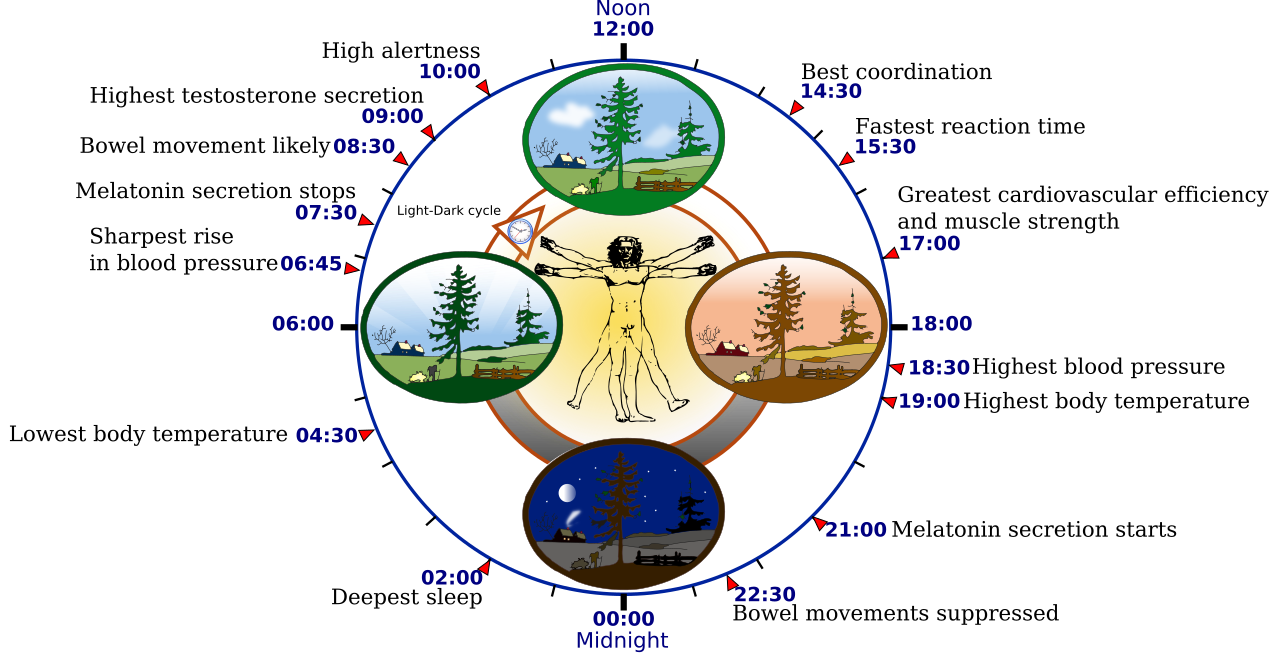
Nearly every cell, tissue and organ in the human body runs on an internal timer. These are circadian rhythms: physical, mental and behavioral changes that repeat on a roughly 24-hour cycle, according to the National Institute of General Medical Sciences (NIGMS), part of the U.S. National Institutes of Health. Light and darkness have the strongest influence on this clock, though food intake, physical activity, stress and ambient temperature also play a role, NIGMS states.
Who runs the body's clock
NIGMS explains that a 'master clock' in the brain coordinates the many smaller clocks found throughout the body. This master clock sits in a cluster of nerve cells called the suprachiasmatic nucleus (SCN). The SCN receives direct signals about light levels from the eyes and uses that information to control production of melatonin, the hormone most closely linked to sleepiness.
When evening light fades, the SCN triggers a rise in melatonin, which helps bring on sleep. NIGMS also notes that the discovery of molecular mechanisms behind these daily cycles — including the role of the PER protein — won three scientists the Nobel Prize in 2017.
What happens when the clock and the environment disagree
The body tries to keep its internal schedule lined up with the outside world's light-dark cycle, eating times and activity patterns. NIGMS and the National Heart, Lung, and Blood Institute (NHLBI) both describe what happens when that alignment breaks down: short-term effects include drowsiness, poor coordination and reduced concentration, while long-term circadian disruption is associated with higher risk of obesity, diabetes, mood disorders, cardiovascular problems and certain cancers.
NHLBI, which classifies these problems as circadian rhythm disorders, says disruption can be temporary — caused by sleep habits, a job, or travel — or long-term, linked to aging, genetics or an underlying medical condition. Common symptoms include extreme daytime sleepiness, reduced alertness and impaired memory or decision-making. The institute adds that populations such as shift workers, international travelers experiencing jet lag, and some patients with autism, Alzheimer's disease or Parkinson's disease commonly experience this kind of disruption.
Shift work: a real-world test case
The U.S. Centers for Disease Control and Prevention's National Institute for Occupational Safety and Health (NIOSH) states that shift work and long working hours harm health largely by 'disturbing sleep and circadian rhythms and reducing time for family and non-work responsibilities.' According to NIOSH training material for nurses, these disruptions can promote stress, fatigue, negative mood, physiological dysfunction and poor health behaviors such as overeating, smoking and inactivity, which in turn raise the risk of illness, injury and workplace errors.
NIOSH's nurse training material does not provide specific percentage increases in disease or accident risk, noting instead that individual worker characteristics and job demands determine how severely these effects appear.
What the evidence says about daily performance
Harvard Health, the publishing arm of Harvard Medical School, advises that the single most important anchor for the circadian sleep rhythm is a consistent daily wake-up time, since waking at the same hour every day helps stabilize the rest of the cycle. The same guidance recommends keeping meals, exercise and other daily activities on a steady schedule, and winding down with dim light and no screens for roughly 90 minutes before bed, because an irregular routine — even one that feels relaxed — can disrupt the circadian rhythm and contribute to insomnia.
Key factors that reset or disrupt the clock
- Light exposure: the SCN uses light and dark signals from the eyes to set the timing of melatonin release, per NIGMS.
- Consistency of wake time: Harvard Health identifies a fixed wake-up time as the main anchor of the sleep-wake cycle.
- Shift work and long hours: NIOSH links irregular work schedules to disturbed sleep, circadian rhythms and reduced recovery time.
- Travel across time zones: NHLBI lists jet lag among the common temporary causes of circadian rhythm disruption.
- Underlying conditions and aging: NHLBI notes that genetics, aging and certain medical conditions can cause longer-term circadian disruption.
| Trigger | Source | Reported effect |
|---|---|---|
| Irregular wake/sleep times | Harvard Health | Can disrupt the circadian rhythm and contribute to insomnia |
| Shift work / long hours | CDC/NIOSH | Disturbed sleep and circadian rhythms; higher stress, fatigue, illness and injury risk |
| Jet lag (travel across time zones) | NHLBI | Listed as a common temporary cause of circadian rhythm disorders |
| Long-term circadian misalignment | NIGMS | Associated with higher risk of obesity, diabetes, mood disorders, cardiovascular disease and certain cancers |
What is still uncertain
The agencies and institutions cited here describe associations and mechanisms rather than universal rules for every individual. NIOSH explicitly states that worker characteristics and job demands influence whether negative health outcomes occur from shift work, meaning not everyone is affected the same way. None of the sources reviewed for this article offer medical treatment advice for specific circadian rhythm disorders; NHLBI notes that treatment is tailored to the specific disorder and its underlying cause by a healthcare provider.
Questions
- What exactly is a circadian rhythm?
- It is a roughly 24-hour cycle of physical, mental and behavioral changes, governed mainly by light and darkness and coordinated by a master clock in the brain called the suprachiasmatic nucleus, according to NIGMS.
- Why does shift work harm sleep and health?
- CDC/NIOSH says shift work and long hours disturb sleep and circadian rhythms, which can promote stress, fatigue and poor health behaviors, raising the risk of illness, injury and errors.
- What is the single most important habit for a stable circadian rhythm?
- Harvard Health identifies a consistent daily wake-up time as the main anchor of the sleep-wake cycle, more important than the exact bedtime chosen.
- What are the long-term health risks of circadian disruption?
- NIGMS and NHLBI link long-term circadian misalignment to higher risk of obesity, diabetes, mood disorders, cardiovascular disease and certain cancers.
- Who is most commonly affected by circadian rhythm disorders?
- NHLBI lists shift workers, international travelers experiencing jet lag, and some patients with autism, Alzheimer's disease or Parkinson's disease as commonly affected groups.
Sources
This piece was prepared with artificial intelligence and passed an automated source check before publication. If you see an error, ask for a correction. Request a correction or reply · How we make this
Related
HealthNews
France Reexamines Meningioma Risk From Androcur and Other Hormone Drugs
A France Télévisions documentary airing this week has revived scrutiny of hormone drugs — led by the anti-androgen Androcur (cyproterone acetate) — over their link to meningioma brain tumors. France's medicines agency ANSM has warned since 2018 that the risk rises sharply with dose and duration, and has tightened prescribing rules, though the drugs remain legally sold.
HealthNews
Salmonella Outbreak Linked to Spanish Eggs Sickens at Least 13 People
At least 13 people in Spain have developed salmonellosis after eating eggs contaminated with Salmonella Enteritidis, according to a European food-safety alert Spanish authorities filed on October 8, 2026. The eggs, produced in Spain, were also distributed to Portugal before being withdrawn from the market.

HealthArticle
How Human Metabolism Works: Why Rates Vary and What It Means for Health
Metabolism is the set of chemical reactions that turn food into usable energy, and resting metabolic rate alone accounts for roughly 60% to 70% of the calories most people burn each day, according to the Cleveland Clinic. How fast that baseline runs depends mainly on body size, muscle mass, sex and age rather than willpower, and a 2021 study in the journal Science found metabolism moves through four distinct stages across a lifetime instead of declining steadily after young adulthood.

HealthNews
Dengue case in Maine-et-Loire's La Séguinière triggers mosquito-control spraying
A resident of La Séguinière, near Cholet in France's Maine-et-Loire department, tested positive for dengue in early October 2026, prompting the regional health agency to plan insecticide spraying in the person's neighbourhood. The operation follows similar interventions this year at Orvault, near Nantes, and last year at Trélazé, as the tiger mosquito that spreads the virus keeps expanding across the region.