Every time a human cell divides, it must first copy all of its DNA so that both resulting cells end up with a complete, identical set of genetic instructions. This copying step is called DNA replication. It is distinct from, but closely linked to, genetic inheritance — the process that explains why children resemble their biological parents.
What Happens During DNA Replication
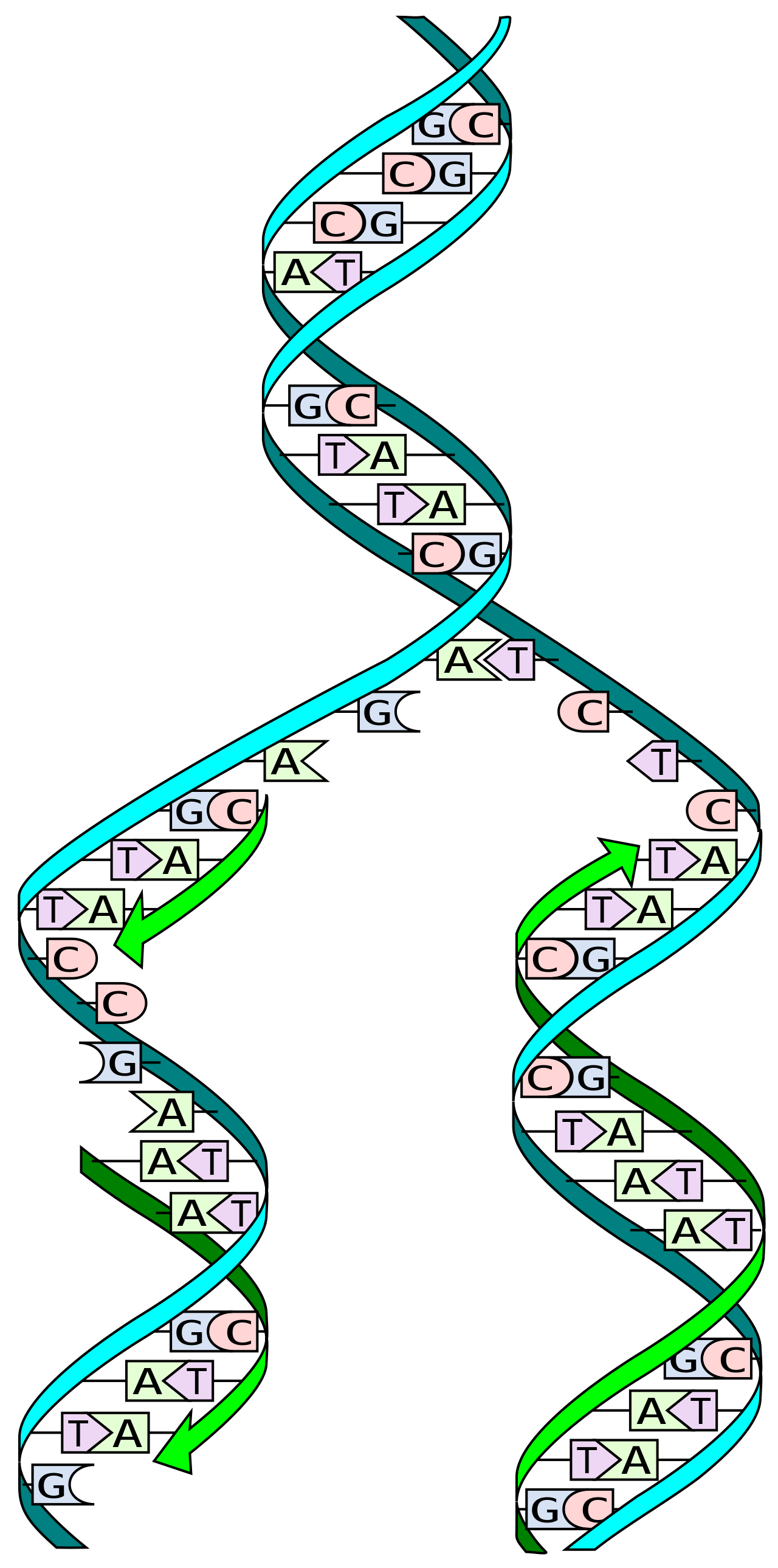
According to the genetics information site yourgenome.org, DNA replication takes place during cell division so that each daughter cell receives an identical copy of the genome. In human cells, the entire process — copying roughly 3 billion base pairs — is completed in about one hour.
Replication is described as 'semi-conservative': each new DNA molecule ends up with one original strand and one newly built strand, rather than two entirely new strands.
The Three Steps
- Initiation: the enzyme helicase breaks the hydrogen bonds holding the two DNA strands together, unwinding the double helix and opening a Y-shaped 'replication fork' where the strands separate.
- Elongation: because the two separated strands run in opposite directions, they are copied differently. On the leading strand, the enzyme primase lays down short RNA primers and DNA polymerase adds new bases continuously. On the lagging strand, DNA polymerase works in short, discontinuous segments called Okazaki fragments.
- Termination: an enzyme called exonuclease removes the RNA primers and fills the resulting gaps, DNA polymerase proofreads the new strand for errors, and DNA ligase seals the fragments into one continuous strand, which then winds back into a double helix.
The National Human Genome Research Institute (NHGRI) describes the same three-stage sequence — initiation, elongation and termination — as the standard framework used across molecular biology to explain how the double helix is unwound, copied and resealed.
How Genetic Inheritance Works
Inheritance is the process by which genetic information moves from one generation to the next. It depends on a different kind of cell division called meiosis. NHGRI explains that human body cells normally hold 46 chromosomes arranged in 23 pairs (a 'diploid' cell), and that meiosis takes a diploid cell through two rounds of division to produce four 'haploid' gametes — eggs or sperm — each containing only 23 chromosomes.
When an egg with 23 chromosomes is fertilized by a sperm with 23 chromosomes, the resulting cell has the full 46 chromosomes again, restoring the normal human chromosome count and combining genetic material from both parents, according to NHGRI.
Mendel's Laws: Dominant and Recessive Traits
The basic rules governing which traits appear in offspring were first worked out by the Austrian monk Gregor Mendel through thousands of 19th-century experiments on pea plants, NHGRI's genetics glossary notes. Mendel's work established that traits are passed down through dominant and recessive versions of genes, now called alleles.
Under this system, an offspring inherits one copy of a gene from each parent. A dominant allele produces its trait even when paired with a different allele, while a recessive allele only produces its trait when both inherited copies are the recessive version. NHGRI cautions that not every trait follows this simple pattern cleanly, and that some Mendelian traits are rare or still being identified through ongoing research.
Inheritance Patterns Behind Genetic Conditions
The U.S. National Library of Medicine's MedlinePlus Genetics resource describes several inheritance patterns that doctors and researchers use to track how gene variants pass through families.
Common human inheritance patterns (MedlinePlus Genetics)| Pattern | Copies needed to show the trait | Key detail |
|---|
| Autosomal dominant | One altered copy | Can come from a parent or arise as a new variant with no family history |
|---|
| Autosomal recessive | Two altered copies (one from each parent) | Parents with one copy are 'carriers' and usually show no symptoms |
|---|
| X-linked | One altered copy in males; generally two in females | Genes sit on the X chromosome; fathers cannot pass X-linked traits to their sons |
|---|
MedlinePlus Genetics also notes that many traits and conditions are not governed by a single gene at all, but result from the combined effect of multiple genes interacting with environmental factors — a pattern that falls outside classic Mendelian inheritance.
Why Replication and Inheritance Are Linked but Different
DNA replication copies genetic material inside a single organism's cells so the body can grow and repair itself. Inheritance, by contrast, concerns how that genetic material is reshuffled and transmitted between generations through meiosis and fertilization. Errors or variants that arise during either process — a mistake during replication, or a particular combination of alleles inherited at fertilization — are what give rise to genetic diversity and, in some cases, inherited conditions.
Questions
- What is the difference between DNA replication and genetic inheritance?
- DNA replication is the copying of DNA inside a cell before it divides, so both resulting cells get an identical genome. Genetic inheritance is the transmission of genetic material from parents to offspring through gametes formed by meiosis and combined at fertilization.
- What are the three steps of DNA replication?
- According to yourgenome.org and NHGRI, the three steps are initiation (the double helix unwinds at the replication fork), elongation (DNA polymerase builds new strands, continuously on the leading strand and in Okazaki fragments on the lagging strand), and termination (primers are removed, errors are proofread, and DNA ligase seals the new strands).
- Why do children inherit traits from both parents?
- Because each parent's gametes (egg or sperm) carry only half the normal chromosome number, 23 chromosomes each, as NHGRI explains. Fertilization combines these halves into a full set of 46 chromosomes, so the offspring's DNA includes genetic material from both parents.
- What is the difference between dominant and recessive alleles?
- A dominant allele produces its trait even if the offspring inherits only one copy of it, while a recessive allele produces its trait only when both inherited copies, one from each parent, are the recessive version, according to NHGRI's genetics glossary.
- Are all inherited traits controlled by a single gene?
- No. MedlinePlus Genetics notes that many traits and conditions result from multiple genes interacting with environmental factors, rather than following the simple dominant/recessive pattern of classic Mendelian inheritance.
This piece was prepared with artificial intelligence and passed an automated source check before publication. If you see an error, ask for a correction. Request a correction or reply · How we make this