Fall brings winter squash, cruciferous vegetables, and root crops that each need different handling. University extension data show the exact ripeness signs, storage temperatures, and shelf lives, while Harvard Health research outlines which cooking methods keep more nutrients intact.
October markets fill with winter squash, broccoli, Brussels sprouts, and root vegetables such as carrots, beets, and potatoes. Unlike delicate summer produce, these crops can keep for weeks or months, but only when buyers check the right ripeness signs and store each type at its own temperature and humidity.
What to Look for Before You Buy
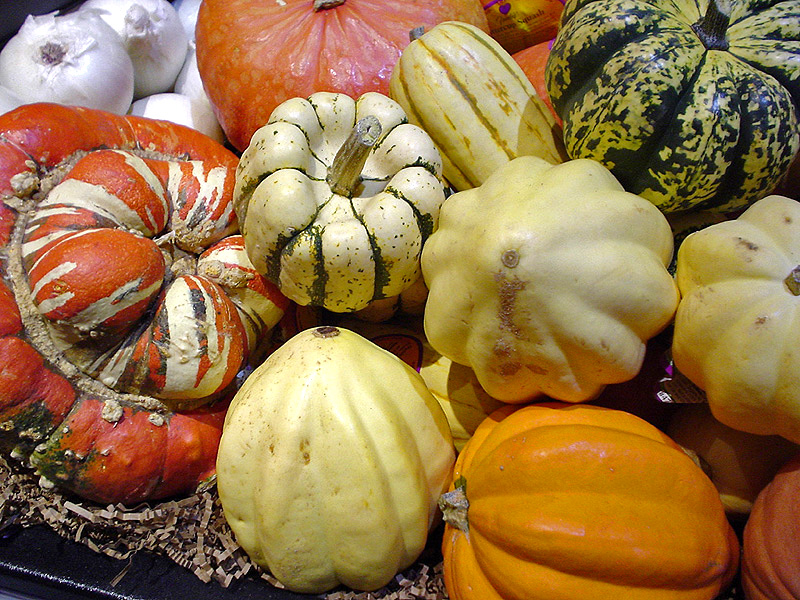
For winter squash and pumpkins, color is not a reliable guide to ripeness. South Dakota State University (SDSU) Extension points to "stem corking" as the clearest sign a fruit is ready: the stem loses its green color and develops brown, woody stripes where it meets the fruit, and the stem may shrink slightly as the fruit separates from the vine. Rinds should also resist a fingernail press, though the exact hardness varies by variety; butternut squash, for example, turns tan two to three weeks before it is actually ready to pick.
the loss of green and the development of brown, woody stripes on the stem where it joins the fruit
— South Dakota State University Extension
For cruciferous vegetables, University of Illinois Extension recommends choosing broccoli with bright green or purplish-green heads and a compact cluster of small flower buds; yellow flowers or enlarged buds signal the head is past its best. Brussels sprouts should be small, compact, and bright green, ideally no larger than 1 to 1.5 inches in diameter, with no yellowing, wilting, or insect damage on the outer leaves.
For root vegetables, SDSU Extension notes that full-size carrots have slightly blunt tips, while beets and turnips are generally harvested around golf-ball size. Vegetables with soft spots, cracks, or sprouting should be set aside, since these are the first areas to break down in storage.
How Long Each Vegetable Keeps — and Where
Winter squash keeps longest in a cool, dry room rather than the refrigerator. SDSU Extension gives a storage range of 50°F to 60°F at 50 to 70 percent relative humidity, with shelf life varying sharply by type. Most root vegetables, such as carrots and beets, along with cruciferous crops, need the cold, humid environment of a refrigerator crisper drawer; potatoes are the exception and are kept in cool, dark, humid storage outside the refrigerator after curing.
Storage conditions and typical shelf life by vegetable
Vegetable
Where to store
Temperature
Typical shelf life
Acorn squash
Cool, dry room (not fridge)
50–60°F
Up to 2 months
Butternut squash
Cool, dry room (not fridge)
50–60°F
2–3 months
Hubbard squash
Cool, dry room (not fridge)
50–60°F
5–6 months
Beets (tops removed)
Refrigerator
32–40°F
2+ weeks
Broccoli (unwashed, perforated bag)
Refrigerator crisper
Standard fridge cold
3–5 days
Brussels sprouts (unwashed, bag)
Refrigerator crisper
Standard fridge cold
1–2 days
SDSU Extension warns against storing winter squash near apples, ripe pears, or tomatoes, since these release ethylene gas that shortens the squash's shelf life. The same source advises keeping potatoes away from apples or tomatoes, as the ethylene they release can cause sprouting, and keeping carrots away from apples, which can give stored carrots a bitter taste.
A Five-Step Routine From Market to Plate
Inspect before buying: check for stem corking on squash, compact florets on broccoli, and firm skin with no soft spots on root vegetables, per SDSU and University of Illinois Extension guidance.
Separate ethylene producers: keep winter squash away from apples, ripe pears, and tomatoes, and keep potatoes and carrots away from apples and tomatoes during transport and storage, as SDSU Extension advises.
Cure what needs curing: SDSU Extension recommends leaving freshly dug potatoes in a dark, ventilated space at 60–68°F for several days to two weeks before moving them to cooler, high-humidity storage.
Match temperature and humidity to the vegetable: winter squash goes in a cool, dry room at 50–60°F, while broccoli and Brussels sprouts go unwashed into perforated bags in the refrigerator crisper, following SDSU and Illinois Extension recommendations.
Cook briefly with minimal liquid: Harvard Health Publishing notes that quick-cooking methods that use little water, such as steaming, best limit nutrient loss.
Cooking Methods That Keep More Nutrients
According to Harvard Health Publishing, the cooking method that best preserves nutrients is one that cooks food quickly, for the shortest time, and with as little liquid as possible. The article points to broccoli as an example: steamed broccoli holds onto more glucosinolate — a sulfur-containing compound with potential cancer-fighting properties — than broccoli that has been boiled or fried, because steaming keeps the vegetable out of direct contact with water.
The same source adds that microwaving vegetables with a small amount of water works on a similar principle, since it effectively steams food from the inside and limits the time nutrients have to leach out. Harvard Health Publishing also notes that the cooking method matters less than whether vegetables are eaten at all.
Questions
How long does winter squash actually keep?
According to SDSU Extension, it depends on the variety: acorn squash keeps up to 2 months, butternut 2–3 months, and hubbard squash 5–6 months, all stored at 50–60°F and 50–70% relative humidity.
Should winter squash be stored in the refrigerator?
No. SDSU Extension's recommended range is 50–60°F, which is warmer than a standard refrigerator; squash is meant to be kept in a cool, dry room instead.
Why shouldn't vegetables be stored near apples?
SDSU Extension explains that apples release ethylene gas that can make stored carrots taste bitter, that apples or tomatoes can make potatoes sprout, and that apples, ripe pears, or tomatoes shorten the shelf life of stored winter squash.
What's the best way to keep broccoli fresh longer?
University of Illinois Extension recommends storing broccoli unwashed in a loose or perforated plastic bag in the refrigerator crisper and using it within 3 to 5 days, washing it only just before cooking.
Which cooking method keeps the most nutrients in vegetables?
Harvard Health Publishing says quick-cooking methods using little liquid, such as steaming or microwaving with a small amount of water, limit nutrient loss better than boiling; steamed broccoli retains more glucosinolate than boiled or fried broccoli.
This piece was prepared with artificial intelligence and passed an automated source check before publication. If you see an error, ask for a correction. Request a correction or reply · How we make this
Growing herbs indoors year-round works by giving plants enough light, well-drained soil, and the right watering rhythm for each species. University extension guides recommend at least 6 hours of light (natural or supplemental), a soilless potting mix with added perlite, and letting Mediterranean herbs like rosemary and thyme dry out between waterings while keeping basil consistently moist.
The Mediterranean diet is a plant-forward eating pattern built on vegetables, whole grains, legumes, nuts and olive oil, with fish and seafood at least twice a week and red meat limited to a few times a month. It was formalized in 1993 by Oldways, the Harvard School of Public Health and the WHO as the Mediterranean Diet Pyramid, and large clinical trials have since linked it to lower cardiovascular risk.
Choosing a wine you'll enjoy starts with matching flavors you already like to a wine's dryness and body, not its price or label design. Storing it means keeping bottles cool, dark and humid, and tasting it comes down to four simple steps: look, smell, taste, conclude.
Home bread baking comes down to four core ingredients, a target hydration, correct yeast temperature, and two tests — windowpane and poke — that tell you when dough is ready. This guide walks through mixing, kneading, rising, shaping and baking a basic loaf using techniques described by King Arthur Baking, The Perfect Loaf, Fleischmann's and Bob's Red Mill.