History · Article
French Revolution: Causes, Key Events and Lasting Global Impact
Published:
In brief
The French Revolution (1789–1799) began as a response to royal debt, unequal taxation and food shortages, and ended with the fall of the monarchy and Napoleon Bonaparte's seizure of power. It abolished feudal privilege, produced the Declaration of the Rights of Man and of the Citizen, and set political patterns later revolutions around the world would follow.
The French Revolution unfolded in France between 1789 and 1799, overturning centuries of absolute monarchy and feudal privilege. According to Wikipedia's overview of the period, the upheaval grew out of a severe state financial crisis, unequal taxation and a political system unable to reform itself, and it ended with Napoleon Bonaparte's coup of 18 Brumaire on 9 November 1799.
What caused the Revolution
By 1788, roughly half of French state revenue was going toward servicing debt, according to Wikipedia, which also notes that tax collection was inconsistent across regions and that the nobility and clergy were largely exempt while commoners carried the heaviest burden. History.com adds that France's involvement in the American Revolution, combined with King Louis XVI's spending, strained royal finances further.
Economic hardship compounded the fiscal crisis. Wikipedia reports that an economic recession beginning in 1785, together with poor harvests in 1787 and 1788, drove up unemployment and food prices just as France's population and middle class were expanding. History.com similarly points to drought, cattle disease and soaring bread prices as sources of mass desperation among peasants and urban workers in the months before the Revolution.
Attempts at reform repeatedly stalled. History.com notes that Controller General Charles Alexandre de Calonne proposed a universal land tax in 1786, but Wikipedia explains that such measures were blocked by regional judicial bodies known as Parlements, forcing Louis XVI to convene the Estates-General — France's traditional assembly of clergy, nobility and commoners — for the first time since 1614.
Key events, 1789–1799
The Estates-General met at Versailles on 5 May 1789. On 17 June 1789, representatives of the Third Estate (commoners) declared themselves the National Assembly, and on 20 June 1789 they took the Tennis Court Oath, pledging not to disperse until France had a new constitution, per both History.com and Wikipedia.
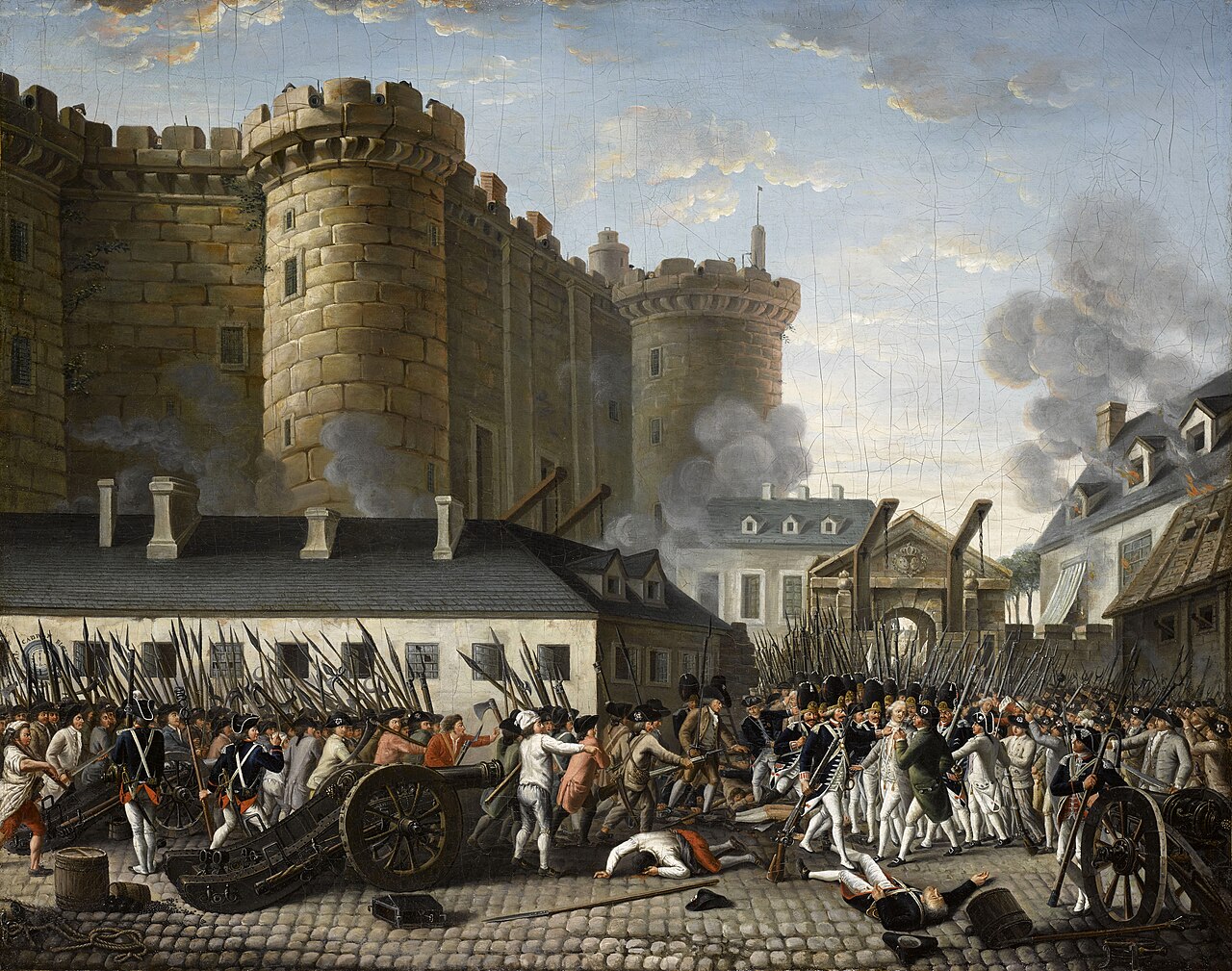
On 14 July 1789, Parisians stormed the Bastille fortress, a symbol of royal authority; History.com describes the crowd's aim as seizing gunpowder and weapons. The National Assembly abolished feudalism and seigneurial dues in the August Decrees of 4 August 1789, and on 26 August 1789 it adopted the Declaration of the Rights of Man and of the Citizen.
According to the official website of the French presidency (Élysée.fr), the Declaration's 17 articles were voted on between 20 and 26 August 1789 and ratified by Louis XVI on 5 October 1789. It drew on the American Declaration of Independence and Enlightenment philosophy, proclaiming that 'men are born and remain free and equal in rights' and establishing liberty, property, safety and resistance to oppression as natural rights, alongside the separation of powers.
The monarchy's position deteriorated further after Louis XVI's failed escape attempt, known as the Flight to Varennes, on 20–21 June 1791, which Wikipedia says discredited the king. Revolutionary France went to war with European powers from April 1792, and on 10 August 1792 an insurrection overthrew the monarchy; the First Republic was proclaimed the following month. Louis XVI was executed by guillotine on 21 January 1793.
The 1793–1794 Reign of Terror, overseen by the Committee of Public Safety under figures including Maximilien Robespierre, marked the Revolution's most violent phase. Sources give different tolls: History.com states that more than 17,000 people were officially tried and executed, while Wikipedia puts the figure at approximately 16,000 executed by the Revolutionary Tribunal. The Terror ended with the Thermidorian Reaction in July 1794, which led to Robespierre's fall and execution.
A more moderate Directory government took over from November 1795, but political instability persisted. On 9 November 1799 (18 Brumaire in the revolutionary calendar), Napoleon Bonaparte seized power in a coup, establishing the Consulate and, in most historical accounts cited by both History.com and Wikipedia, bringing the Revolution to a close.
| Date | Event |
|---|---|
| 5 May 1789 | Estates-General convenes at Versailles |
| 17 June 1789 | Third Estate declares itself the National Assembly |
| 20 June 1789 | Tennis Court Oath |
| 14 July 1789 | Storming of the Bastille |
| 4 August 1789 | August Decrees abolish feudalism |
| 26 August 1789 | Declaration of the Rights of Man and of the Citizen adopted |
| 20–21 June 1791 | Flight to Varennes; Louis XVI's escape fails |
| 10 August 1792 | Monarchy overthrown |
| 21 January 1793 | Execution of Louis XVI |
| 1793–1794 | Reign of Terror (approx. 16,000–17,000+ executed, per Wikipedia and History.com respectively) |
| 9 November 1799 | Napoleon's coup ends the Revolution |
Lasting global impact
The Declaration of the Rights of Man and of the Citizen outlasted the turbulence that followed it. Élysée.fr states that although competing declarations appeared in 1793 and 1795, the 1789 text became the authoritative version, forming the basis for French constitutions of 1852, 1946 and 1958, and influencing similar rights documents across Europe and Latin America in the 19th century. The same source traces the Universal Declaration of Human Rights (1948) and the European Convention on Human Rights (1950) directly back to the 1789 Declaration.
Beyond France's borders, historian Donald Sassoon, writing for Literary Hub, cites fellow historian Immanuel Wallerstein's description of the Revolution as 'a world-historical event' and historian Lynn Hunt's observation that it established templates for 'parties, ideologies, dictators, mass movements' later followed by socialist and communist movements into the 20th century. Sassoon notes that the French tricolor flag design was later adopted by nationalist movements in Italy, Germany, Belgium, Hungary and Mexico, and that revolutionary songs such as 'La Marseillaise' were performed by movements as distant as Chicago anarchists linked to the 1886 Haymarket affair and Russian military bands marking the tsar's overthrow in 1917.
The French Revolution was 'a world-historical event.'
Within France itself, Wikipedia notes the Revolution is widely regarded by historians as marking the start of the modern political era, having ended feudalism, transferred power from the Catholic Church to the state, and established popular sovereignty and constitutional government as organizing principles — ideas that later movements for democracy across Europe and Latin America, and events such as the Haitian Revolution, drew upon.
Why the Revolution is still studied
The Revolution is taught globally because it produced lasting institutional templates — written constitutions, declarations of rights, and the modern nation-state — while also illustrating how revolutionary change can escalate into violence, as seen in the Terror. The tension between its founding ideals of liberty and equality and its violent phases remains a core reason historians and educators continue to revisit it.
Questions
- What were the main causes of the French Revolution?
- A state financial crisis driven by debt and unequal taxation, combined with poor harvests, rising bread prices and economic recession in the 1780s, created widespread hardship; reform attempts were repeatedly blocked by privileged groups and regional judicial bodies, forcing Louis XVI to convene the Estates-General in 1789.
- When did the French Revolution start and end?
- Most accounts, including Wikipedia and History.com, date it from the convening of the Estates-General on 5 May 1789 to Napoleon Bonaparte's coup on 9 November 1799.
- How many people died during the Reign of Terror?
- Figures vary by source: History.com states more than 17,000 people were officially tried and executed, while Wikipedia cites approximately 16,000 executions by the Revolutionary Tribunal during 1793–1794.
- What was the Declaration of the Rights of Man and of the Citizen?
- Adopted by the National Assembly between 20 and 26 August 1789 and ratified by Louis XVI on 5 October 1789, it proclaimed liberty, property, safety and resistance to oppression as natural rights and established the separation of powers, according to the French presidency's official site, Élysée.fr.
- How did the French Revolution influence the rest of the world?
- Writing in Literary Hub, historian Donald Sassoon cites historian Lynn Hunt's view that the Revolution set patterns for later political parties, ideologies and revolutionary movements worldwide, while Élysée.fr notes its 1789 rights declaration directly influenced the Universal Declaration of Human Rights of 1948.
Sources
This piece was prepared with artificial intelligence and passed an automated source check before publication. If you see an error, ask for a correction. Request a correction or reply · How we make this
Related

HistoryList
Seven Ancient African Civilizations and the Legacy They Left Behind
Long before European colonization, the African continent was home to powerful states that built pyramids, ran trans-Saharan gold-and-salt economies, and raised cities of carved stone. This list ranks seven ancient African kingdoms by the scale of their political, economic or architectural reach, based on dates and figures from historians, UNESCO and museum records.
HistoryArticle
From ARPANET's First Packet to a 6-Billion-User Internet: A Timeline
The internet began as a U.S. defense research network called ARPANET in 1969 and became the World Wide Web two decades later through a 1989 proposal at CERN. Today roughly 6 billion people — about three-quarters of the world's population — use the internet, according to the UN's International Telecommunication Union (ITU).

HistoryArticle
How Archaeologists Determine the Age of Fossils and Artifacts
Archaeologists use two broad approaches: relative dating, which orders finds by layer or style without giving a year, and absolute (scientific) dating, which uses physical or chemical changes — such as carbon-14 decay, tree-ring patterns or potassium-argon decay — to estimate a calendar-based age range. Most sites are dated by combining several of these methods rather than relying on one alone.
HistoryArticle
Ancient Rome's Government, Society and Legacy, Explained
Ancient Rome ran its affairs through elected magistrates, a senate of former officials and popular assemblies for roughly five centuries before power concentrated in a single emperor from 27 BCE. Its rigid social hierarchy, its legal code and its Latin tongue went on to shape European and wider Western institutions long after the empire itself fell.