History · Article
From ARPANET's First Packet to a 6-Billion-User Internet: A Timeline
Published:
In brief
The internet began as a U.S. defense research network called ARPANET in 1969 and became the World Wide Web two decades later through a 1989 proposal at CERN. Today roughly 6 billion people — about three-quarters of the world's population — use the internet, according to the UN's International Telecommunication Union (ITU).
The global network now called the internet did not start as a consumer product. It grew out of a U.S. government research project in the late 1960s, was rebuilt on a common technical standard in the 1980s, and only became the point-and-click 'Web' that most people recognize after a proposal written at a European physics laboratory in 1989.
ARPANET: the Cold War-era starting point
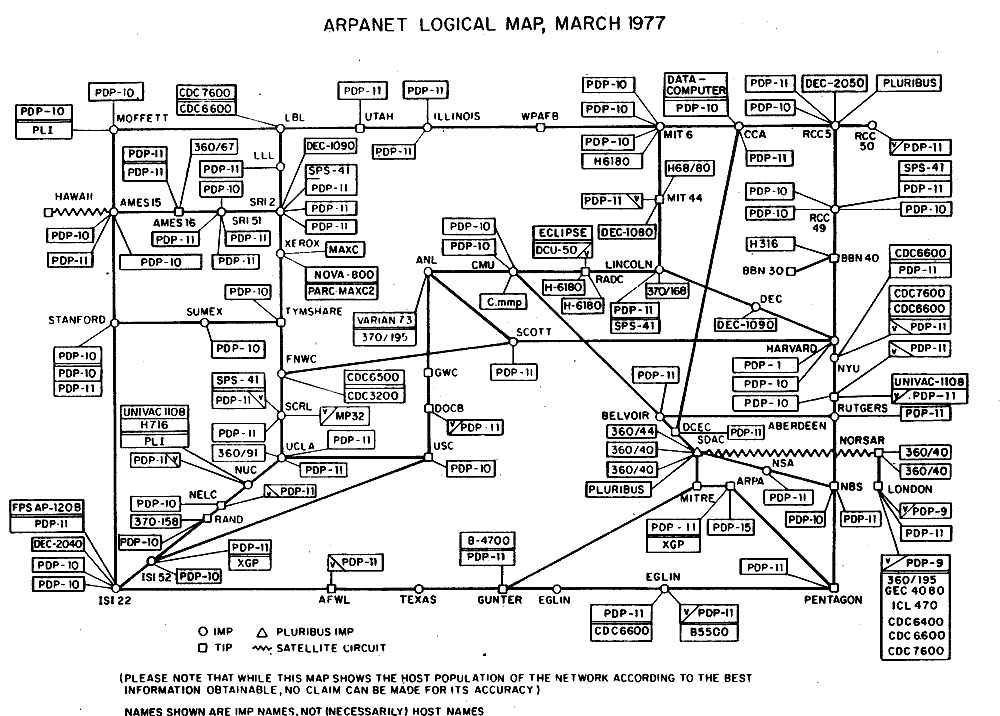
According to the U.S. Defense Advanced Research Projects Agency (DARPA), ARPANET was created in the late 1960s under program manager J.C.R. Licklider to allow secure communication and information-sharing between geographically dispersed research facilities. The network began with four nodes: UCLA, the Stanford Research Institute, UC Santa Barbara and the University of Utah.
The first signal between two of those nodes was transmitted on October 29, 1969, according to DARPA's log of the event. A UCLA researcher attempted to type the word 'login' on a computer connected to a machine at the Stanford Research Institute, but the system crashed after only the letters 'L' and 'O' went through, according to History.com's account of the day. UCLA professor Leonard Kleinrock had been developing packet switching — breaking data into small blocks that could be reassembled after transmission — which History.com and DARPA describe as the foundational technique that made the network, and later the internet, resistant to single points of failure.
TCP/IP and the 1983 'flag day'
By 1973, researchers had built several competing packet-switching systems, DARPA notes. Vint Cerf and Robert Kahn then designed the Transmission Control Protocol and Internet Protocol (TCP/IP), a shared language that let separate networks interconnect. The first TCP/IP implementation ran at Stanford in 1975.
The Internet Society's history of the project describes January 1, 1983, as a 'flag day': every host on ARPANET had to switch from the older NCP protocol to TCP/IP simultaneously. DARPA states that by January 1983 enough separate networks had interconnected using this protocol that ARPANET had, in effect, become the internet. TCP/IP had also been adopted as a U.S. defense standard in 1980, and by 1990 it had displaced most rival wide-area networking protocols worldwide, per the Internet Society.
NSFNET and the spread beyond the military
The U.S. National Science Foundation built on this foundation with NSFNET, established in 1985 and requiring TCP/IP from the start, according to the Internet Society. The backbone grew from six 56-kilobit-per-second links to 21 nodes carrying multiple 45-megabit-per-second connections before it was defunded in April 1995, at which point its resources were redistributed to regional networks supporting commercial internet access. By 1990, the Internet Society says, more than 50,000 networks existed across all seven continents, while ARPANET itself was formally decommissioned that same year.
The World Wide Web: a 1989 proposal at CERN
The internet and the World Wide Web are not the same thing: the internet is the underlying network, while the Web is a system of linked documents that runs on top of it. According to CERN, British scientist Tim Berners-Lee drafted the first proposal for the Web in March 1989 while working at the Geneva-based laboratory. He resubmitted it in 1990 and, with Belgian engineer Robert Cailliau, formalized it as a management proposal in November 1990.
By the end of 1990, Berners-Lee had a working server and browser on a NeXT computer at CERN, which he marked with a handwritten warning not to switch it off. CERN says the first website, info.cern.ch, went live around this time, and the software was shared with CERN colleagues in March 1991 before Berners-Lee announced it publicly on Internet newsgroups in August 1991. A pivotal moment for adoption came on April 30, 1993, when CERN made the WorldWideWeb source code available on a royalty-free basis, making it free software.
From dial-up to 6 billion users
Commercial internet service grew through the 1990s as NSFNET's federal backbone wound down and private providers took over. Decades later, the United Nations' International Telecommunication Union (ITU) estimates that about 6 billion people — roughly three-quarters of the world's population — were using the internet in 2025. The ITU says 2.2 billion people remained offline in 2025, down from a revised 2.3 billion in 2024.
Access remains uneven. The ITU reports that 94% of people in high-income countries use the internet, compared with 23% in low-income countries, and that 96% of the world's offline population lives in low- and middle-income countries. Urban users (85% online) significantly outnumber rural users (58% online), and the ITU also records a gender gap of 77% of men online versus 71% of women globally.
On mobile networks, the ITU says 5G subscriptions reached roughly 3 billion in 2025, about one-third of all mobile broadband connections, but with sharply unequal coverage: 84% of people in high-income countries have 5G access versus 4% in low-income countries. The ITU adds that users in high-income countries generate nearly eight times more mobile data than those in low-income countries.
| Year | Milestone | Source |
|---|---|---|
| 1969 | First ARPANET signal sent between UCLA and Stanford Research Institute | DARPA |
| 1975 | First TCP/IP implementation runs at Stanford | DARPA |
| Jan. 1, 1983 | ARPANET-wide 'flag day' switch to TCP/IP; DARPA says ARPANET had, in effect, become the internet | DARPA / Internet Society |
| 1985 | NSFNET established, mandating TCP/IP | Internet Society |
| March 1989 | Tim Berners-Lee submits first World Wide Web proposal at CERN | CERN |
| August 1991 | Berners-Lee announces the Web publicly on Internet newsgroups | CERN |
| April 30, 1993 | CERN makes WorldWideWeb source code available royalty-free, as free software | CERN |
| April 1995 | NSFNET backbone defunded; shift to commercial providers | Internet Society |
| 2025 | ITU estimates 6 billion internet users worldwide (about three-quarters of global population) | ITU |
This machine is a server. DO NOT POWER IT DOWN!!
Questions
- Who sent the first message over the internet's precursor network?
- A UCLA researcher sent it toward the Stanford Research Institute on October 29, 1969, according to DARPA and History.com. The intended word was 'login,' but the system crashed after transmitting only the letters 'L' and 'O.'
- Is the internet the same thing as the World Wide Web?
- No. The internet is the underlying global network of interconnected computers, built on protocols like TCP/IP. The World Wide Web is a system of linked documents that runs on top of that network, proposed by Tim Berners-Lee at CERN in 1989.
- When did ARPANET become 'the internet'?
- DARPA states that by January 1983, after a network-wide switch to the TCP/IP protocol, enough separate networks had interconnected that ARPANET had, in effect, become the internet.
- How many people use the internet today?
- The ITU estimates about 6 billion people, roughly three-quarters of the global population, were using the internet in 2025, while 2.2 billion people remained offline.
- Why was CERN's 1993 decision to release the Web's source code important?
- On April 30, 1993, CERN made the WorldWideWeb source code available on a royalty-free basis, turning it into free software. CERN's own account attributes the Web's subsequent rapid spread mainly to the release of user-friendly browsers such as NCSA's Mosaic, introduced earlier that year, rather than to the source-code release itself.
Sources
This piece was prepared with artificial intelligence and passed an automated source check before publication. If you see an error, ask for a correction. Request a correction or reply · How we make this
Related

HistoryList
Seven Ancient African Civilizations and the Legacy They Left Behind
Long before European colonization, the African continent was home to powerful states that built pyramids, ran trans-Saharan gold-and-salt economies, and raised cities of carved stone. This list ranks seven ancient African kingdoms by the scale of their political, economic or architectural reach, based on dates and figures from historians, UNESCO and museum records.

HistoryArticle
How Archaeologists Determine the Age of Fossils and Artifacts
Archaeologists use two broad approaches: relative dating, which orders finds by layer or style without giving a year, and absolute (scientific) dating, which uses physical or chemical changes — such as carbon-14 decay, tree-ring patterns or potassium-argon decay — to estimate a calendar-based age range. Most sites are dated by combining several of these methods rather than relying on one alone.
HistoryArticle
Ancient Rome's Government, Society and Legacy, Explained
Ancient Rome ran its affairs through elected magistrates, a senate of former officials and popular assemblies for roughly five centuries before power concentrated in a single emperor from 27 BCE. Its rigid social hierarchy, its legal code and its Latin tongue went on to shape European and wider Western institutions long after the empire itself fell.
HistoryArticle
Italian Renaissance: How Leonardo and Michelangelo Transformed Art and Culture
The Italian Renaissance was a cultural and artistic movement that began in Florence in the late 1300s and reshaped European art, science and thought for centuries. Its most famous figures, Leonardo da Vinci and Michelangelo, produced works—the Mona Lisa, the Last Supper, the David, the Sistine Chapel ceiling—that still define the period. This piece explains the movement's origins, its key patrons, and why these two artists remain its central reference points.