History · Article
The History of Democracy: From Ancient Athens to Modern Governance
Published:
In brief
Democracy as a system of rule by citizens dates back to Athens around 508–507 BC, when the reformer Cleisthenes restructured the city-state's constitution. From there it spread unevenly through Roman representative institutions, medieval limits on royal power, Enlightenment theory, and later expansions of political rights to today's mix of electoral and liberal democracies worldwide.
The word "democracy" comes from the Greek dēmokratia, meaning rule by the people, and its first well-documented practice emerged in the city-state of Athens. But the roughly 2,500-year path from the Athenian assembly to today's parliaments, congresses and electoral commissions was neither straight nor continuous. It ran through republics, monarchies limited by law, revolutions, and 20th-century reversals before reaching the patchwork of political systems that exist now.
Athens: the first documented democracy
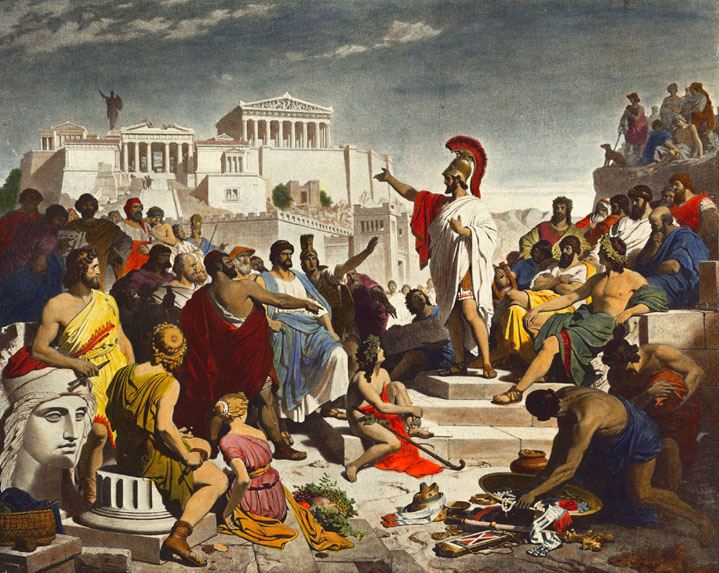
According to History.com, Athenian democracy took shape after the tyrant Hippias fled the city in 510 BC, when Sparta invaded. Two or three years later, the Athenian aristocrat Cleisthenes introduced constitutional reforms, traditionally dated to 508–507 BC, that are credited with putting Athens on a democratic footing. Cleisthenes shifted the basis of political identity from family and clan membership to residence in a locality, which reduced the power of aristocratic family networks.
Athenian democracy was direct rather than representative: citizens voted on laws themselves instead of electing people to vote for them. The World History Encyclopedia describes the system's core institutions. The Assembly, or Ekklēsia, met on the Pnyx hill at least monthly and could hold around 6,000 citizens; any male citizen could speak and vote by a show of hands. A Council of 500 (the Boulē), chosen by lot for one-year terms and representing the 139 local districts of Attica, set the Assembly's agenda and handled day-to-day business. Courts staffed by roughly 6,000 jurors chosen annually by lot could review and strike down laws passed by the Assembly.
Random selection by lot, known as sortition, was central to the system: a device called the kleroterion used colored tokens to assign citizens to public offices and juries, a method meant to prevent any individual or faction from monopolizing power, according to the World History Encyclopedia.
The system excluded far more people than it included. Only free adult male citizens could participate — women, enslaved people and foreign residents (metics) had no political voice. History.com notes that citizenship rules tightened over time: initially a man needed only an Athenian father, but by the mid-5th century BC both parents had to be Athenian. Of an eligible citizen population estimated at roughly 30,000, only about 5,000 to 6,000 typically attended any given Assembly meeting.
Athenian democracy did not last uninterrupted. History.com states it "officially ended in 322 BC," when Macedonia imposed an oligarchic government on the city after a military defeat, although the World History Encyclopedia dates the system's main functioning period to roughly 460–320 BC.
Rome, Magna Carta and limits on royal power
Athens was not the only ancient experiment in shared rule. The Roman Republic, which the civic-education site DemocracyWeb.org dates from the sixth to first centuries BC, built representative rather than directly democratic institutions: a Senate drawn from the aristocracy and a Plebeian Council representing commoners, alongside written law codified in the Twelve Tables. The Republic collapsed in the first century BC amid class conflict, giving way to military rule and, eventually, autocratic rule under Augustus.
Centuries later, medieval England produced a different kind of constraint on power. The Magna Carta, agreed in 1215 as a peace settlement between King John and his barons, did not create democracy or universal rights, but it established that the king was subject to the law rather than above it — a principle that, per DemocracyWeb.org, fed into the later development of Parliament, which by the 14th century had split into the hereditary House of Lords and the elected House of Commons.
Conflict between the Crown and Parliament resurfaced in the 17th century. According to DemocracyWeb.org, King Charles I's attempt to rule without Parliament from 1625 to 1640 triggered the English Civil Wars, and the 1688 Glorious Revolution forced out King James II, leading to the English Bill of Rights, which cemented Parliament's authority over succession and taxation.
Enlightenment theory and the age of revolutions
Philosopher John Locke (1632–1704) argued that governments derive their legitimacy from the consent of the governed, a position DemocracyWeb.org describes as directly opposed to Thomas Hobbes's defense of absolute sovereignty. Locke's ideas, along with Jean-Jacques Rousseau's concept of the "general will," fed directly into the political language of the late 18th century.
The 1776 United States Declaration of Independence and the subsequent US Constitution built a republic organized around consent of the governed, though suffrage was initially restricted largely to property-owning white men. The 1789 French Revolution produced the Declaration of the Rights of Man and of the Citizen; DemocracyWeb.org notes its republican ideals inspired movements elsewhere even as the revolution itself descended into internal violence.
The uneven global spread of democratic rights
Research published by Our World in Data traces how slowly democratic rights actually spread after these 18th-century declarations. Around 1800, only the United Kingdom and the United States counted as electoral autocracies with limited representative features, covering about 22 million people combined. By 1900, three-quarters of humanity still lacked meaningful political rights; only about 14 million people, in Australia, Belgium and Switzerland, lived under what the research classifies as liberal democracy, while roughly 41 million more, in France and New Zealand, lived under electoral democratic protections.
Where things stand today
Our World in Data's figures show the scale of post-war change: by around 1950, roughly 200 million people lived in liberal democracies, mostly in Western Europe, with another 230 million in electoral democracies. By the late 1990s, a majority of the world's population — about 3 billion people — lived under electoral or liberal democratic systems, and by 2016 more than 2.8 billion lived under electoral democracy specifically, with about 1 billion under liberal democracy.
That expansion has since partly reversed. Our World in Data points to India's 2017 reclassification as an electoral autocracy as one marker of a broader trend, concluding that more than two-thirds of the world's population currently live in countries classified as closed or electoral autocracies.
| Period | Development | Source |
|---|---|---|
| 508–507 BC | Cleisthenes's reforms establish Athenian democracy | History.com |
| 460–322 BC | Direct democracy functions in Athens via Assembly, Council of 500 and courts | World History Encyclopedia |
| 6th–1st century BC | Roman Republic develops representative Senate and Plebeian Council | DemocracyWeb.org |
| 1215 | Magna Carta limits royal power in England | DemocracyWeb.org |
| 1688 | Glorious Revolution and English Bill of Rights strengthen Parliament | DemocracyWeb.org |
| 1776 / 1789 | US Declaration of Independence and French Revolution apply consent-of-the-governed theory | DemocracyWeb.org |
| 1900 | Only ~14 million people live under liberal democracy worldwide (Australia, Belgium, Switzerland) | Our World in Data |
| 2016–present | Global share of population under electoral/liberal democracy peaks, then declines as countries like India are reclassified as electoral autocracies | Our World in Data |
Questions
- When did democracy begin in ancient Athens?
- Historians commonly date the start of Athenian democracy to 508–507 BC, when the aristocrat Cleisthenes introduced constitutional reforms after the fall of the tyrant Hippias, according to History.com.
- How did Athenian democracy actually work?
- It was a direct democracy: eligible male citizens voted on laws themselves in the Assembly, a Council of 500 chosen by lot set the agenda, and courts staffed by jurors chosen by lot could strike down laws, per the World History Encyclopedia.
- Who could participate in Athenian democracy?
- Only free adult male citizens with Athenian parentage could vote or hold office; women, enslaved people and foreign residents were excluded, History.com reports.
- When did Athenian democracy end?
- History.com states Athenian democracy officially ended in 322 BC, when Macedonia imposed an oligarchic government on the city after a military defeat.
- Is the world more or less democratic today than a decade ago?
- According to Our World in Data, the share of the global population living in electoral or liberal democracies has declined since a peak around 2016, partly because of reclassifications such as India's move to electoral autocracy in 2017; the organization estimates more than two-thirds of people now live under electoral or closed autocracies.
Sources
This piece was prepared with artificial intelligence and passed an automated source check before publication. If you see an error, ask for a correction. Request a correction or reply · How we make this
Related
HistoryGuide
How to Research Your Family History: A Step-by-Step Genealogy Guide
Genealogy guides from the U.S. National Archives, FamilySearch and the Smithsonian Libraries recommend starting with time-sensitive steps — interviewing living relatives and preserving old photographs and documents — before searching historical records such as census, military, immigration and land files. All three stress keeping a research log, citing original sources and building timelines to track progress. DNA testing can supplement, but not replace, document-based research.
HistoryArticle
From Barter to Digital Currency: How Money Evolved Across Civilizations
Money moved from direct barter to livestock and shell currencies, then to metal coins, paper notes, and today's electronic payments and central bank digital currencies. Each shift solved a practical problem of trust, portability or scale, according to the Bank of England and the IMF.

HistoryNews
Expedition reaches Nikumaroro to search for Amelia Earhart's lost plane
A 16-to-17-member expedition led by the Archaeological Legacy Institute and Purdue University is approaching the remote Pacific atoll of Nikumaroro to inspect a sonar/satellite anomaly called the "Taraia Object," which researchers say could be wreckage of Amelia Earhart's Lockheed Electra 10-E. The team departed Tarawa, Kiribati on October 7, 2026 and expected to reach the atoll around midday on October 12 local time, after which it plans about five days of diving, dredging and remote-sensing work.

HistoryArticle
The Renaissance: How Art and Science Reshaped Europe, 14th–17th Centuries
The Renaissance was a cultural and intellectual movement that began in 14th-century Florence and spread across Europe by the 17th century, reviving classical learning and reshaping art, science, and education. It bridged the medieval and modern worlds through humanism, new artistic techniques such as linear perspective, and scientific breakthroughs including the heliocentric model of the solar system.