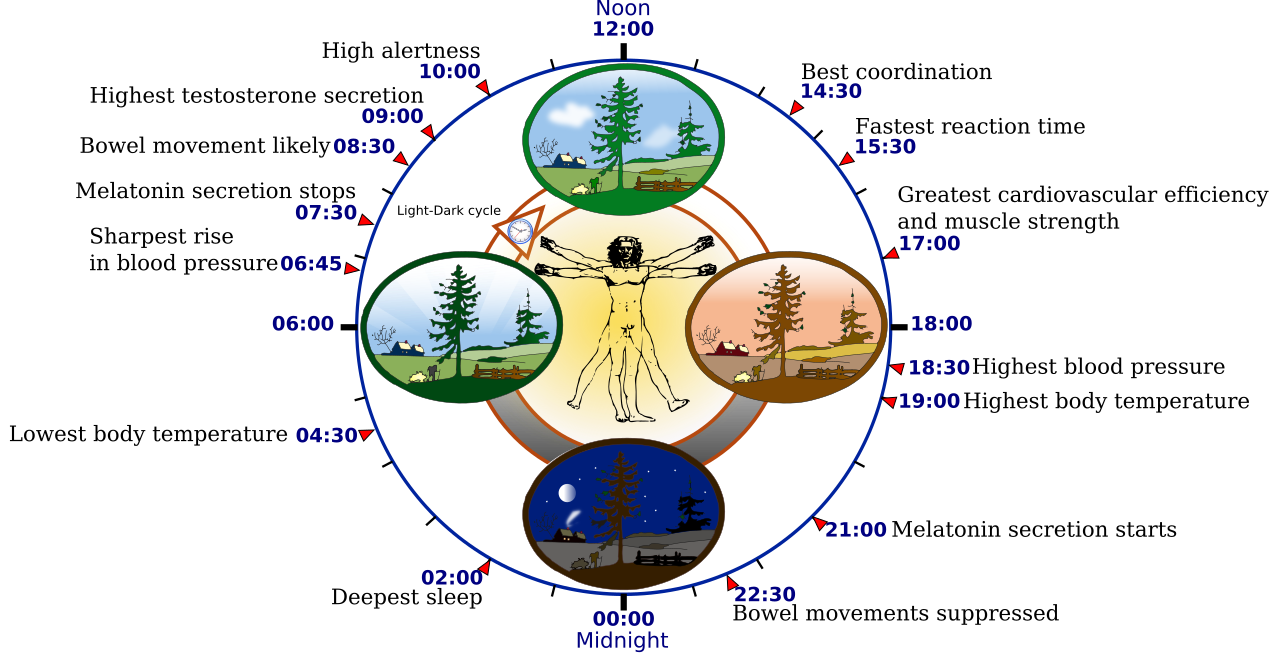
Circadian rhythms are the physical, mental and behavioral changes the body goes through on a roughly 24-hour cycle, according to the National Institute of General Medical Sciences (NIGMS), part of the US National Institutes of Health. Light and darkness are the main cues that set this clock, though food intake, stress and temperature also play a role.
What controls the body's internal clock
NIGMS identifies the suprachiasmatic nucleus (SCN), a cluster of nerve cells in the brain's hypothalamus, as the body's master clock. The SCN receives light signals from the eyes, regulates melatonin production, and synchronizes the timing of organs and tissues throughout the body.
A 2020 peer-reviewed review published on PubMed Central describes the SCN as containing roughly 50,000 neurons that operate through molecular feedback loops involving genes known as Per and Cry. The same review explains that sleep itself is governed by two interacting systems: a circadian driver that promotes alertness by day and sleep at night, and a separate 'sleep pressure' system that builds the longer a person stays awake.
What happens when the clock is disrupted
According to NIGMS, short-term circadian misalignment — such as jet lag — causes drowsiness and reduced focus, while prolonged disruption is associated with higher risks of obesity, diabetes, mood disorders, cardiovascular and blood-pressure problems, and cancer, and can worsen existing conditions.
The PubMed Central review cites laboratory data showing that restricting sleep in healthy young men altered appetite-regulating hormones, lowering leptin by about 17% and raising ghrelin by about 28%. The same review notes that the World Health Organization's International Agency for Research on Cancer classifies night shift work as 'probably carcinogenic to humans' (Group 2A), and that sleep disruption is linked to elevated cortisol via the body's stress-hormone system.
Short sleep is common among US workers
A CDC report based on 2010 National Health Interview Survey data found that 30.0% of employed US adults — about 40.6 million workers — reported sleeping six hours or less per day, below the 7-to-9-hour range the National Sleep Foundation recommends for healthy adults. The gap was wider among people working night shifts than those on day shifts.
Share of US workers reporting six hours or less of sleep per day (CDC, 2010 data)| Worker group | Share with ≤6 hours sleep |
|---|
| All employed adults | 30.0% |
|---|
| Day shift workers | 28.8% |
|---|
| Night shift workers | 44.0% |
|---|
| Night shift, transportation & warehousing | 69.7% |
|---|
| Night shift, health care & social assistance | 52.3% |
|---|
The economic cost of lost sleep
RAND Corporation research, reported by Carrier Management, estimated that insufficient sleep costs the US economy $411 billion a year, equal to about 2.28% of gross domestic product. RAND attributed most of this to lost productivity rather than absenteeism alone, estimating 1.23 million missed working days annually linked to sleep deprivation, alongside an increased mortality risk.
The same RAND analysis found a potential upside: if Americans currently sleeping under six hours a night increased their sleep to six-to-seven hours, the shift could add an estimated $226.4 billion to the US economy, according to the Carrier Management report.
What health agencies say helps alignment
The PubMed Central review lists measures associated with better circadian alignment in the research it surveys, including getting morning light exposure, keeping a consistent sleep schedule, keeping the bedroom cool, dark and quiet, and limiting caffeine in the afternoon. For night shift workers, the review also points to workplace measures such as brighter workplace lighting and chronotype-based shift scheduling as partial mitigations studied in shift-work settings.
NIGMS notes that in 2017 researchers Jeffrey Hall, Michael Rosbash and Michael Young won the Nobel Prize for identifying the molecular mechanisms — including the PER protein — that control circadian rhythms, work that continues to inform studies of sleep disorders and conditions such as Parkinson's disease.
This piece was prepared with artificial intelligence and passed an automated source check before publication. If you see an error, ask for a correction. Request a correction or reply · How we make this